

The English word ‘sport’ has acquired meanings that differ substantially from the term that was originally affixed to ‘fishing.’ In many’s ways, this makes perfect sense: language changes and must adapt to contemporary usage or go extinct. Perhaps “sport fishing” is simply an outdated expression, a historical artifact at best. Is there anything worthwhile in the notion of sport fishing for today’s angler? What are the origins and development of this way of sporting? This way of speaking about angling? To be clear, my aim is not to constrain our nomenclature nor to scold anyone about their terminology. I am interested in the concepts that inhabit our speech. I want to better understand what, exactly, the expression “sport fishing” might means for us today.
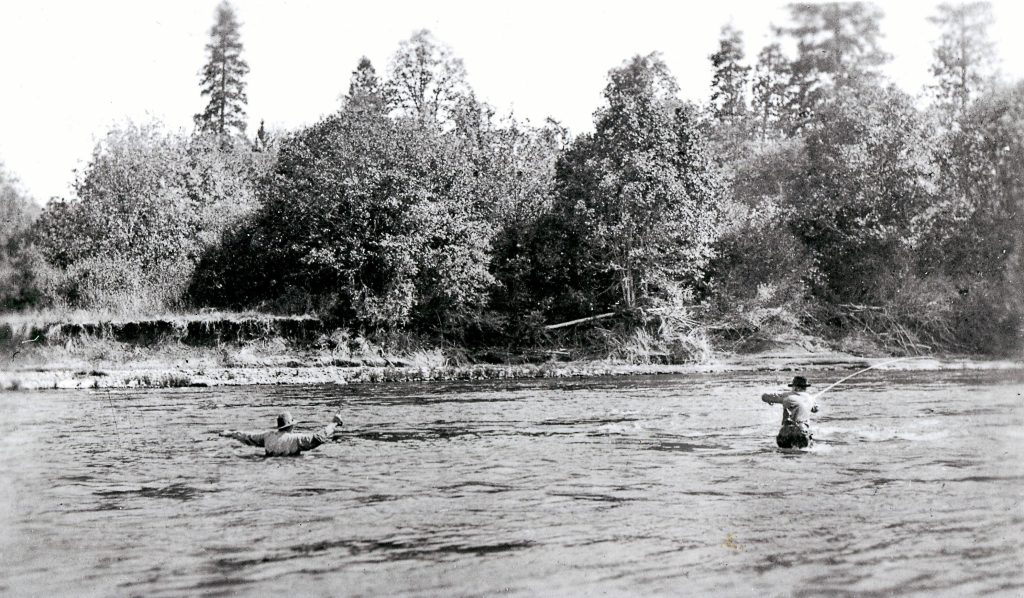
In this essay, I will try to sketch a few notions of sport fishing applicable to the type of angling most relevant to readers of this journal. By that I refer to the British traditions of Atlantic salmon fishing with double-handed rods that originated in Scotland and Wales—specifically referring to the “Spey cast” and “Welsh throw”—during the 19th century. I will also refer to the global spread of these tradition to include Pacific salmon and steelhead fishing in the Pacific Northwest of North America during the 20th century.
The early modern to post-industrial evolution of the British culture of fishing took ancient human activities like hunting and fishing and gentrified them into activities reserved for the noble classes. This, in turn, created different classes of animals: game animals like game fowl and sport fish. The transformation of prehistoric human hunter-gatherer behaviour into an activity for landed leisure classes fundamentally changed fishing from work into play, from a form of survival and sustenance into recreation and entertainment.
In this sense, we might begin to understand sport fishing as a particular historical approach to fishing rooted in play or recreation as opposed to the necessities of commerce and sustenance. This British cultural history married its English words ‘sport’ and ‘fishing’ into the compound linguistic expression used to this day. More importantly, it made the activity of fishing into something distinct from others forms of fishing, which required the added designation of “sport.” This cursory glance at the cultural history of British angling reveals a fascinating inversion of the human activity of fishing. A class of people who by definition do not manually labour—i.e., the leisure classes—recreate by doing something that approximates toil.
This aristocratic reversal is tells an incomplete story. There are numerous complexities and apparent contradictions that resist an oversimplified origin story. Two I will not be able to address are the ecological effects of industrialism that surely played a role alongside the carry- overs from feudal society and, perhaps surprisingly, the relatively higher access to sport for gentry women. The two I will mention briefly are the rise of fishing for coarse fish—such as chub, dace, pike, and perch and, later on, carp—during the same period of time as sport fishing’s gentrification and privatization. The second is the way the exportation of British sport fishing challenged the knowledge and methods and eventually changed the application and, in many respects, the prevailing attitudes and moral sentiments of sport fishing.

Roderick Haig-Brown goes into detail on the practice of coarse fishing in England in A River Never Sleeps. He remarks that “a keen angler, even though he happens to be a poor man, can find a lot of fishing in England.” Hail-Brown shows great respect for the tools and skills of this type of angling and also remarks on the negative and positive consequences of the post- industrial privatization of riparian zones in England in the very same chapter.
(Photo – Les Johnson Haig-Brown: Haig-Brown walking out of the Campbell in the late 1950s, photographed by Van Egan, shared by Art Lingren with permission.)
As we will see, Haig-Brown’s remarks from 1946 contributed to an egalitarian and pragmatic attitude that did not entirely abide by the British cultural division between coarse and game anglers of the 19th century (a division that in many ways persists to this day) while also not blurring the distinction between bait and fly fishing. If we follow this understanding, sport fishing might express something more than generic gentrification. This may not relieve sport fishing of its elitist class sentiments, but it does attune and specify it as more than a working type of leisure. More precisely, sport fishing becomes a subdivision within British post-industrial angling. This definition of sports fishing is slightly less attached to the determinism of British class society, because it focuses on tackle and methods, and opens the door to an elevation of a different sort.
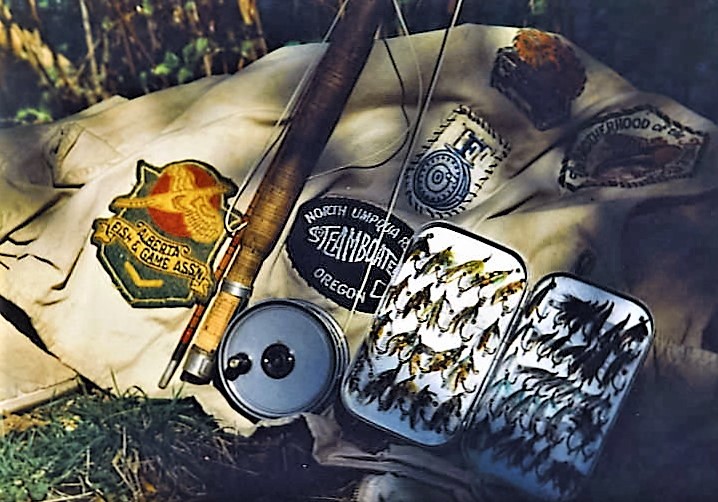
In Part Two of Fisherman’s Summer, Haig-Brown makes use of the distinction we have just observed, between coarse bait angling and sport fly angling, in the story of Captain John Gordon’s failure to catch Pacific salmon on a fly, leading to the early view that Pacific salmon were “unsporting” and not true game fish. While historically inaccurate, Haig-Brown does note that “legend has blamed Gordon’s disgust the unsporting salmon for the loss of Oregon Territory to British Columbia.” Trey Combs’ account in The Steelhead Trout is consistent with Haig- Brown’s. Combs writes, “to ‘properly’ angle for these [Pacific salmon] fish, and this meant with the fly, was a terribly unsuccessful experience.” Of course, it is well documented that steelhead were not believed to take flies at all, and therefore would not have been counted as game fish on this criteria.
These accounts show that the sport fishing of British cultural history did not transition seamlessly around the world, especially to the Pacific Northwest of North America. This applied as much to social class as it did to classifications of fish and animals. While the canonical Haig-
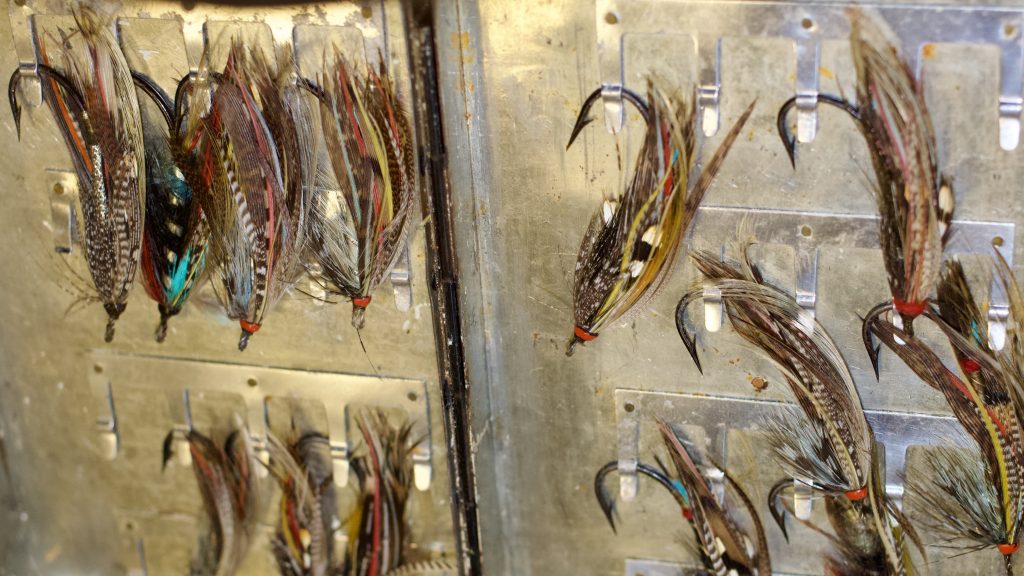
Brown might be seen as a transitional figure bringing continuity to sport fishing from his British birthplace to his home in Campbell River, British Columbia, his writings differ substantially from the likes of Isak Walton, a royalist, and other primary texts, along with the social histories of British fishing culture. Haig-Brown reforms sports fishing, alongside other North American conservationists like Lee and Joan Wulff and several others, as much as he preserves its European cultural inheritance.
Sport fishing for Haig-Brown is no longer deterministically tethered to social class and finds meaningful solidarity with coarse fishing methods as much as with Indigenous teachings and practices, however distant the two may seem from fly angling. Regarding the latter, again in Fisherman’s Summer, published in 1959, he writes:
“In his primitive time, and often still today, the Indian seeks to propagate the gods and enlist their aid to his greater success, because his tools are limited. When I choose to limit my tools and go out on the water or into the hills, I bring myself into dealing with those same gods; my means of propagation are little changed, and my triumphs are as readily comprehensible to my Indian brother as his to me.”
In this extended passage, and many others across his writings, I believe we catch a glimpse of a reformed vision of sport fishing, however disputable the comparative limitations of Indigenous fishing tools may be. Haig-Brown’s sense of sport fishing clearly has a more egalitarian and less aristocratic class sensibility, despite his cultural fluency in British class structure. He has a deep understanding and appreciation of North American fisheries, unlike the generations of Europeans that arrived before him, and his prowess as an angler shows it. But these reforms are in many ways to be expected and do not substantially change the meaning of “sport” in sport fishing so much as to perhaps consign it to historical trivia.
Haig-Brown retains an elevated sense of sport fishing for the angler and the game fish, but here the elevation is not strictly social or even ecological so much as a form of transcendence that verges on natural religion and mysticism and certainly contains an ethical dimension. Sporting is no longer an aesthetical social difference so much as a moral endeavor premised on self-restraint and the acceptance and even imposition of unnatural limitations. The “sport” of sport fishing is no longer the amusement of the gentry game angler nor the respite of the working coarse angler; in many ways the designation of “sport” to sport fishing ceases to be instrumental to any social class as a pastime and the game fish acquire a proportional intrinsic value in turn, beyond their use-value as food or trophies.
Continuities and future uncertainty notwithstanding, the shift in the concept of sport from a type of social leisure to “dealing with those same gods,” whoever and wherever they may be, marks a significant and, to my mind, salutary progression of the human mind and spirit. It is hopefully sufficient to suggest, in a preliminary and still speculative way, that there may be something worthwhile in this notion of sport fishing for today’s angler. This is not to say that sport fishing ought to remain unchallenged or unchanged, but perhaps, inspired by Haig-Brown, there may still be a history of the concept to be written by our community of spey anglers?
This research benefited from time spent at the Hawthorne Collection at the Woodward library of the University of British Columbia; special thanks to Sally Taylor and Art Lingren and the Harry Hawthorne Foundation for the Inculcation and Propagation of the Principles and Ethics of Fly Fishing.
