
2026 Pre-Season Hopefulness
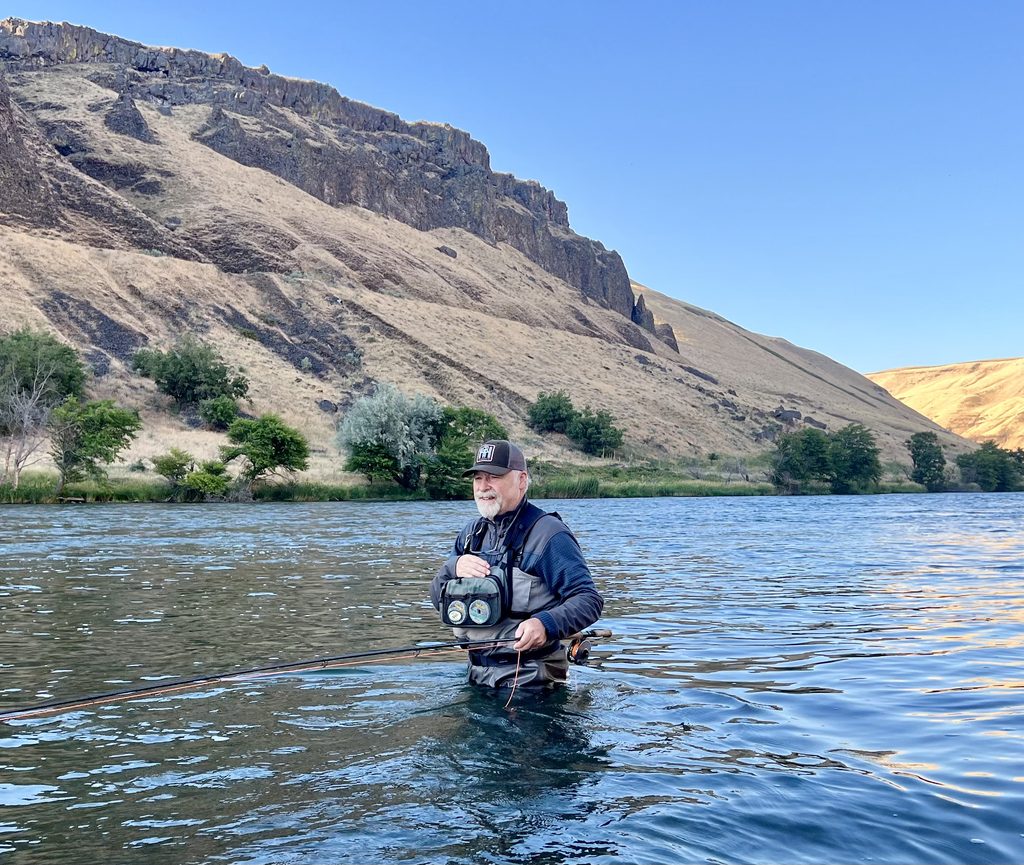
I began tracking the 2026 Columbia River Summer Steelhead run in mid June prior to an annual river trip on the Deschutes. The preseason forecast was okay, but since the state agencies were a mile off in their 2025 forecast, I was only mildly hopeful to see that the 2026 return was only 60 fish off the 2025 return.
However, after a lovely but nearly fishless 6 days of fishing water I know well, I was anxious to get back to my desk and take a look at the passage counts when at the end of the first week in July.
The early trend had not held up – even a little bit – and the return numbers since then have been quite poor.

There will be no joy in Muddlerville over the dwindling 2026 wild steelhead return, and any sort of “October Surprise is not likely. ”
The Fountain of Youth
As my youthful fascination with fishing of all sorts grew, my birthday and Christmas wish list began to yield useful things like annual subscriptions to the top outdoor magazines of the day. I read all of the articles about fishing everywhere, but I leaned hard into western steelhead from those early-to-mid 1970’s articles. If I close my eyes, I can see the accompanying photographs of Oregon and Washington anglers catching massive bright fish in dense forest landscapes with casting and spinning gear.
These anglers wore work clothes, knee high rubber boots, wool jackets and sturdy hats. They plunked from the bank or drifted in small dorys. The fish photos were almost universally classic grip and grin.
While it would be a dozen or more years before fin clipping of hatchery steelhead was more universal, these robust western steelhead catches – from the 1950s through the early 1970s featured the real McCoy – wild steelhead – bright, bulky fish with small heads and big tails or big heads and even bigger tails.
Whether on the Eel River in California, the Kalama River and the Bogachiel in Washington, or Idaho’s Clearwater before the dams, anglers enjoyed relatively robust wild steelhead returns that were as predictable as the rain.
For me, it was the straightforward writing of Ted Trueblood about the Snake, Clearwater and Salmon that really hooked me on the classic western steelhead. I read everything I could find, and tried to convince my family that late summer or early fall camping in Montana, Idaho and Oregon would be the ultimate vacation for all of us.
As happens, a young man’s passions will shift, wobble and reform around a new focus, and for me, it was a deeper love of the mountains, but focused on snow instead of moving waters.
Years later I followed the Oregon Trail to Mount Hood where on my second day in the Beaver State, I received my 2-hour western fishing information baptism at Mark Bachman’s great fly shop in Welches, Oregon, just a day before being swallowed up by law school in Portland. However my fishing good luck continued when I was invited on my first Deschutes fishing trip over the Labor Day holiday in August 1987 – and classes did not start until after the holiday.
Though I had been in Oregon all of three days, I was now joining a group of anglers for their annual trip to the Deschutes River. I was captivated by the Columbia River Gorge and the transition from Cascade forests to the desert environment and rolling hills giving way to the Deschutes River Canyon. On arriving at our campsite, I saw a good fish take a fluttering Caddis out in front of camp – so I promptly rigged up and caught that fish on my first cast.
After fishing until dark, what I learned about about the consequences of my obsession was that 1.) I was the last person to set up their tent, in the dark, with a borrowed headlamp and on sloping ground since all the good sites had been taken) and 2.) Hubris is real as after the success of my first cast, I was skunked the rest of the weekend.
However, most importantly, I was later introduced to Columbia Basin steelhead as I had a front row seat when one of my hosts hooked a shining bright summer steelhead whose jumps and cartwheels left both of us breathless and my friend with one less steelhead fly.
While it would be a few years until I landed my first wild steelhead after that inaugural 1987 trip, I have had the pleasure and good fortune of standing in a lot more moving water that has passed downstream towards the Pacific, including years of great abundance as well as alarming low returns – such as in 1994 – then again in 2021 and now 2026’s low mark.
<<Photo>>
In 1997, amidst those lean years, almost every single steelhead population in the Columbia River were listed as threatened species under the federal Endangered Species Act, and several wild steelhead populations in the upper Columbia River were listed as critically endangered.
Yet, after becoming an ESA-listed species based on the strong downward trend underlying those lean mid-90s returns, Columbia River wild summer steelhead runs partially rebounded, producing some robust wild steelhead returns during a period of relatively high survival and abundance that lasted from 1999 until 2016.
While there are narrative prognostications about upwellings, spring freshets, good spawning conditions and high levels of marine forage in the North Pacific, these metrics from the agencies seemed to be off-kilter with actually being able to use the mass of observed data points to enable forecasts of adult steelhead returns with any accuracy year-in, year-out during this period. Given the acceleration of climate change impacts in the past decade, agency steelhead forecasts may as well be prayer flags in the wind.
Nevertheless, from 1998 thru 2016, no fewer than 39,000 wild steelhead passed Bonneville Dam. It was the closest I would get to what has more regularly seemed like a time gone by – a period of time when the abundance was often matched by good fishing, and even some catching.
But 2016 was an unpleasant jolt of reality as the wild steelhead component dropped 60% from the 2015 return. The 2018 wild return dropped an additional 10%.
Even though the trend was down, three short years later, the 2021 wild steelhead return would shock everyone.
What alarmed and disappointed me the most was the lackadaisical response by the state fishery agencies on both sides of the Columbia Rivers to this very low return. Wild fish activists had to press the Fish and Wildlife Commissions to adopt conservative regulations that led to closures that season on several rivers. A possible silver lining is that 2021’s depressed return and resulting fishery closures prompted Oregon to develop fishery “frameworks” that have attempted to tie fishing seasons and regulations to critical population thresholds with the incoming wild steelhead return and passage.
While there have been tweaks to the original approach, the framework has provided anglers and guides with some measure of certainty, though the approach leaves the fish facing ongoing angler pressure especially when their numbers are close to the critical threshold minimums.
Columbia River Summer Steelhead – A Story of Woe – and Resilience – A Mid-July Panic
I sent out my first memo to alert anglers, managers and the media about the poor status of the 2026 upriver return of wild summer steelhead in mid-July.
Back in the spring of 2026, state agencies predicted a mildly lower steelhead return than had returned in 2025 in their 2026 pre-season forecast, but the early actual 2026 return was well below expectations for even that prediction.
As of mid-July 15, wild summer steelhead passage was 37% of 2025’s passage Bonneville Dam (BON), and only 53% of the current ten-year average passage total between 2016-25 ( a common management metric used by the state agencies).
Another concern was that wild summer steelhead, which typically represent a larger portion of the overall combined early returning steelhead, only comprising 36% of the combined wild and hatchery summer steelhead passing Bonneville.
One additional metric to keep in mind is that at times, up to ten percent of the unclipped or “wild” run are actually unclipped hatchery fish, something that is not parsed out until sometime next year.
Apologies Folks: Why It’s Worse Than You Think
The state agencies typically manage using the most recent or current 10 year average (CTYA) because they believe that the most appropriate comparisons between returns are made based on that timeframe. While the CTYA is instructive, it hides the longer term slide wild steelhead are currently in, which allows the CTYA to feed into and support what many scientists define as the “declining baseline syndrome” a well known trap that hides or ignores what we are losing year-by-year as well as decade-by-decade.
Anyone can use the Columbia River DART’s tool to look at past times of much greater wild steelhead abundance. I have reviewed the available data extensively, hunting for the periods of high wild steelhead abundance as well as periods of poor productivity and abundance since fish passage started after the completion of Bonneville dam in 1938. It is important to know that a full review is limited due to the onset of hatchery steelhead and full marking of hatchery steelhead as a management tool which did not really kick in until the late 1980s.
The historic period with the highest returns of wild steelhead passage past Bonneville (based on return data from 1939 to present) was the ten-year period between 2000 and 2010. I’ll refer to this period as the best 10-year average (BTYA).
Agency managers have criticized reference to the BTYA because they say it is disconnected from current environmental conditions that make the current ten-year average more relevant for management decisions in the current season. However, there are actually few examples where current metrics or conditions within a 10 year period are effectively or accurately used to account for variation in the steelhead returns from year to year.
I am not a scientist and certainly not an expert in the modeling that is often referred to by agencies, but I try to make sense of publically available data.
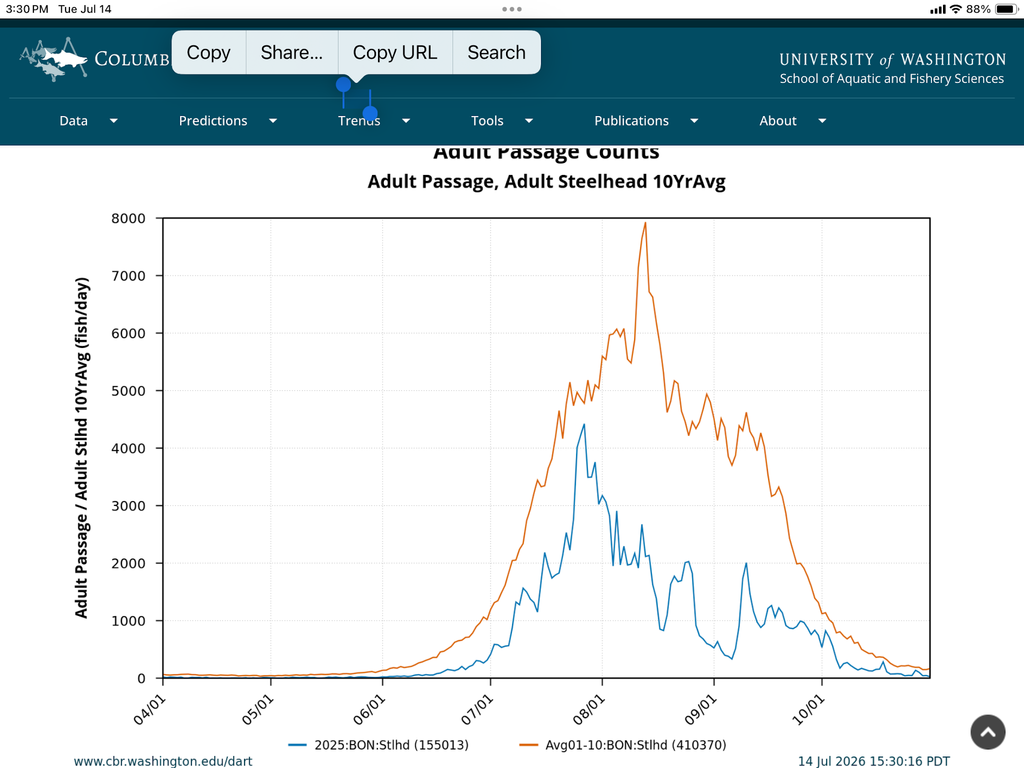
The following graphs are based on actual returns during specific time series and they clearly show what the Pacific Northwest has lost in terms of overall wild steelhead abundance in less than 30 years.
The first graph compares the current 2026 return through the end of August to the 2000-2010 best ten year average over the same time period (referred to as BTYA).

That yawning gap you see on the right axis between the orange and blue lines represents the “Lost Wild Steelhead of the Columbia-Snake Basin since 2010.” The current 2026 return is 18% of the AVERAGE yearly return FOR AN ENTIRE DECADE, one that is only 16 years past.
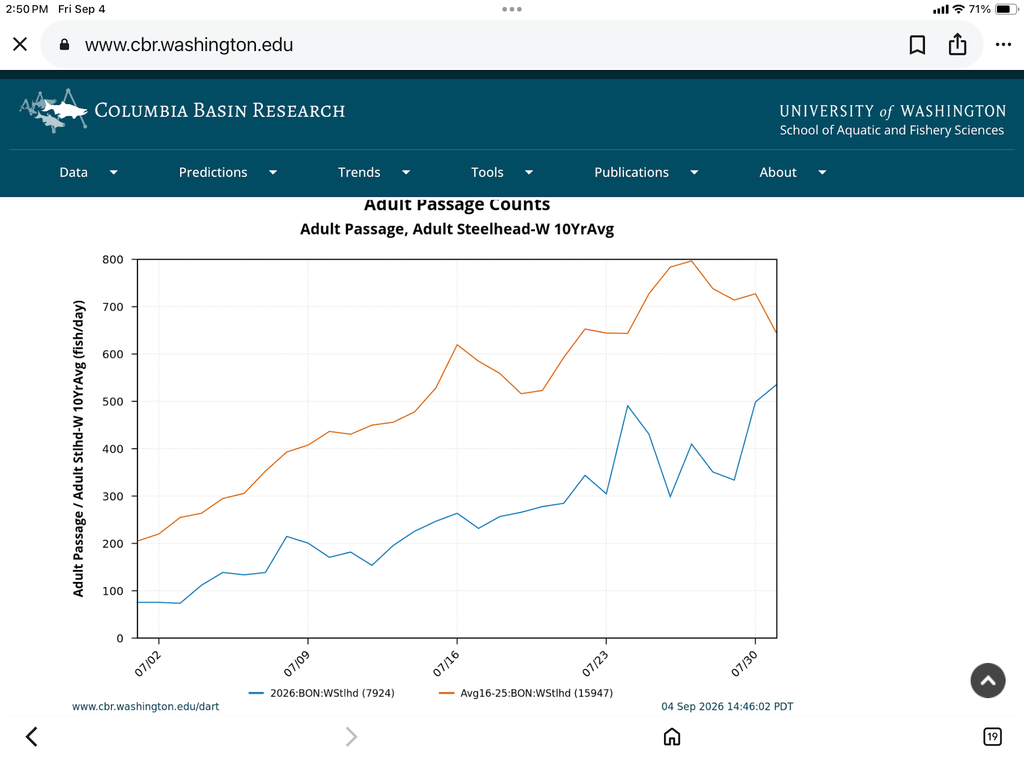
For comparison’s sake, the next graph shows the current 2026 wild steelhead return compared with the wild steelhead return from last year.

The next graph compares how the 2025 combined wild and hatchery steelhead return (which felt like a pretty good overall return) stacks up against the BTYA from 2001-10.
My intent in sharing these comparative data was to ensure steelhead anglers were well aware early on that 2026 would be a very poor year for wild summer steelhead in the Columbia and Snake Basin rivers.
The 2026 Columbia River Summer Steelhead Return: An Ongoing Story of Woe and Fishery Frameworks
Oregon Department of Fish and Wildlife (ODFW)’s Deschutes Fishery Framework sets the magic number of 9,900 wild steelhead passing Bonneville Dam in July based on an apparent correlation to wild steelhead passing Sherars Falls.
As of July 31, the passage of Columbia River wild summer steelhead had not improved over the course of the month, and Oregon anglers and guides crash-landed in (partial) sportfishing closures.
Comparing July wild steelhead passage in 2026 to 2025, the 2026 wild steelhead component was 25% of last year’s wild return past Bonneville.

The 2026 wild steelhead return in July was only 50% of the current ten-year average (2025 through 2016, which happens to be – no surprise, the lowest ten year average on record).
Comparing 2026 wild run to the most productive ten-year period for wild steelhead (2001 to 2010) this year’s return April thru August), is 19% percent (17,867 wild steelhead passing Bonneville since April 1, compared to an average return of 95,447 wild steelhead during that ten-year period.
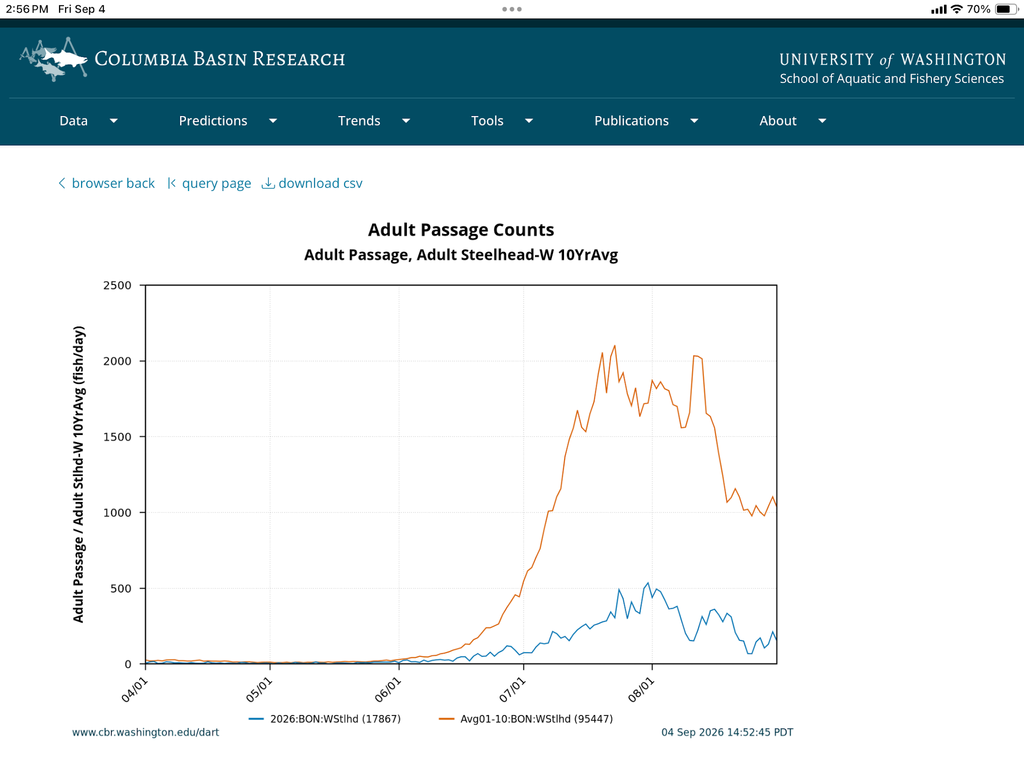
Many question the management link connecting Bonneville Dam passage and wild fish homing to the Deschutes. This relationship or correlation deserves ongoing scrutiny.
Others are concerned that the 9,900 figure is cutting it too close to the bone – that management has set up a situation where the red-light and green-light opener can presumably blink on or off with the passage over Bonneville Dam of a single fish under or over the 9,900 wild steelhead figure – this is especially concerning since the Deschutes Rivers own critical threshold is a mere 625 wild steelhead counted at ODFW’s Sherar Falls ladder and fish trap. The Deschutes 625 wild fish figure is well below the previously relied upon spawning escapement figures used during the 1990 Deschutes River Plan Development (closer to 6,000 wild fish). ODFW disavowed that number after sticking with it for a few decades as a metric of the Deschutes’ wild fish status. Other research that was part of the early 2000s FERC relicensing process make note of specific adult escapements to various Deschutes tributaries (many which have been blocked by dams and other industrial infrastructure) also provide evidence of much larger escapements.
No matter which escapement number is more accurate, managing the fishery now based on 625 wild steelhead is a recipe for disaster considering the angler pressure, the well-measured current encounter rate, and the impact of climate change on the small spawning streams that regularly lack sufficient flows for fish access, as well as the water management in the Deschutes below Pelton Dam where cold water is routinely withheld, thus adversely affecting the Cold Water Refuge at the Deschutes’ confluence with the Columbia.
Finally, worth repeating, and always on my mind is that the wild count at Bonneville is based on seeing an adipose fin – and there are years when unclipped hatchery steelhead comprise more than 10% of the total intact adipose count at Bonneville – an estimate that is eventually determined after this year’s run data is evaluated sometime next year.
2026 Columbia River Summer Steelhead: A Story of Woe and Wondering “What Can We Do?”
As Yogi Berra noted, it’s not over until it’s over.
2026’s Wild steelhead Return has now increased enough in the past few days that it has crept above 2021 as the lowest wild run in the last several decades.
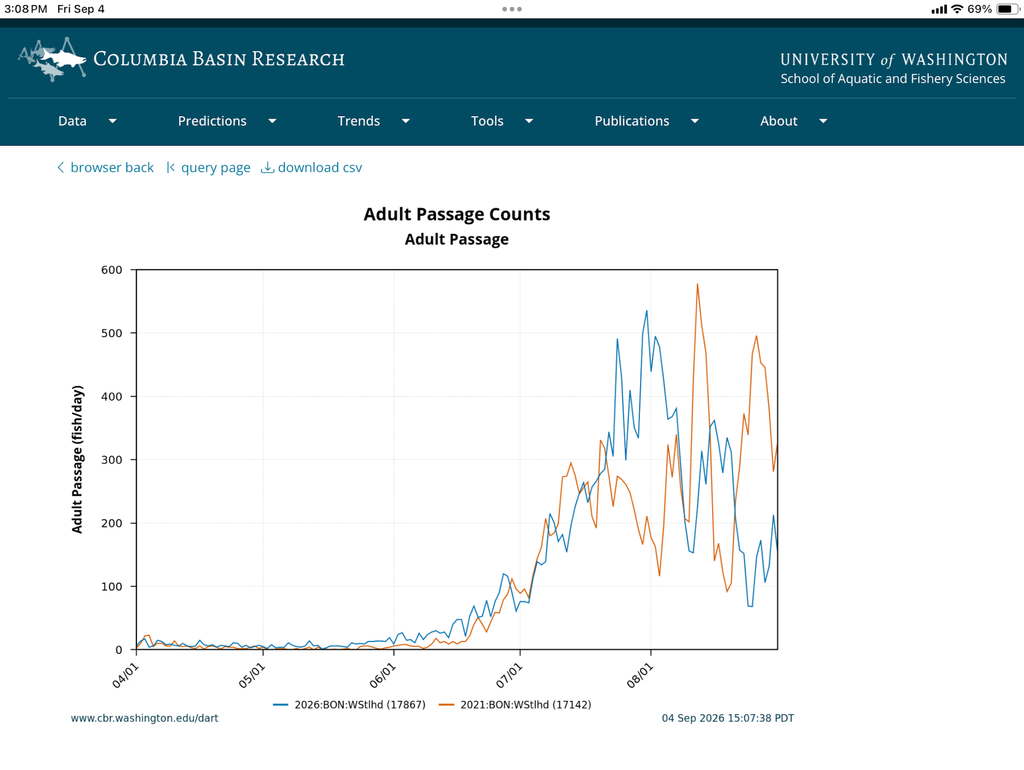
There is little satisfaction there, as sitting on the beach through closures on the Deschutes and now on the John Day River is our painful reality under the framework we are working with.
However, I believe we are all entitled to feeling worn out and absolutely unsatisfied by the almost predictable inconsistency by the fish and wildlife agencies in terms of greater inaccuracy of forecasting, inaccuracy that is also increasing in frequency.
For instance, let’s take a close look at the WA & OR 2026 Forecast.

While predicting the future for wild steelhead is a great deal more complicated than predicting which film wins the Oscar or which MLB teams will meet in the World Series, preseason steelhead forecasts are much more important because management prescriptions (ie. Columbia River fishing seasons) are set based on the forecast – presumably to give some certainty to fishers and anglers, but in reality almost all of the risk of this falls on the fish.
The preseason forecast also sets steelhead sport seasons and rules in lower Columbia River where anglers have been fishing off the beaches and in boats for four months.
The preseason forecast is also used to set mainstem commercial gill net salmon fisheries in Zone 4 & 5 (between the Lewis River and Bonneville Dam) – given the intensity of these fisheries during the prime of salmon and steelhead passage, and the lack of standardized onboard observers to prove out just how many wild steelhead are encountered during these nighttime fisheries, many believe these gillnet openings should be curtailed or cancelled based on the very low steelhead return numbers.
Finally, and lastly, while OR, WA and tribal fisheries are set cooperatively, the States do have authority to limit when and where tribal sales of wild steelhead to the public take place, and by not acting, the precarious status of wild steelhead is not amplified to the public. Few things make less sense than to look into a cooler in Cascade Locks filled with ice and wild steelhead selling for $ per pound when recreational anglers are prohibited from even fishing for them in catch and release fisheries.
While the forecasts and subsequently the angling regulations for salmon are often revised based on monitoring of in-season angler catch or passage counts at Bonneville Dam, why shouldn’t the forecasts and fishing seasons ever factor in environmental conditions such as the winter and spring drought, resulting low streamflows and warm water temperatures that all greatly affect migratory behavior and survival?
The state and federal agencies must revise and improve their forecasting tools and responsive management actions so that there are in-season actions that result in more wild steelhead reaching their homewaters.
The total number of wild steelhead crossing Bonneville between April 1 through August 31 is 17,867 wild fish. Where are these fish likely heading?
Wind River, White Salmon, Hood River, Rock Creek, 15 Mile Creek, Klickitat, Deschutes, John Day, Umatilla, Walla Walla, then over McNary Dam and into the Snake River and a dozen other rivers and up the Upper Columbia and into another dozen rivers.
<<Photo>>
Against this backdrop, wild steelhead comprise only 36% of the total return so far in 2026.
Wild steelhead smolts are likely outnumbered by hatchery steelhead smolts ten to one – about 11 or 12 million hatchery steelhead smolts are released each year in the Columbia Basin upstream of Bonneville Dam. Current survival rates for hatchery steelhead smolts are between 1 and 3 percent. If hatchery steelhead smolts survived to return as adults at a 2 percent rate, there should be nearly 240,000 hatchery steelhead adults returning past Bonneville Dam.
Confirming this survival and productivity failure for hatchery-produced salmonids, a recently published peer-reviewed analytic report on the overall failure of hatchery production and supplementation to achieve intended production of salmon and steelhead as mitigation for the in the mid-Columbia and Snake River dams finds that hatchery fixes or increased hatchery production will not solve the abundance problems.
I also worry about the wild fish that are in the river now, while fishing is open, because most of the encounter data from sport fisheries document that wild steelhead are encountered slightly more than half the time – despite being outnumbered by hatchery fish, thus resulting in more angler-caused mortality for fish that must be released unharmed.
As an angler focused on wild steelhead, it is during times like these that I say to my friends, acquaintances, and enemies, please check yourself.
Bigger Picture Actions for Mid Columbia Steelhead
Sorcery, Science or Ballpark Prognostications
An issue that must come out of its black box are the run forecasting formulas that fishery managers are using, but failing to improve. The forecasts are important because they are used to set sport and commercial fisheries in the Columbia and in major tributaries.
In the past ten years, Oregon and Washington regularly have been spectacularly wrong in their steelhead forecasts. No one complains when the actual return comes in well above the pre-season forecasts (not sure if they pat each other on the back or wipe their brow in relief), but the point is that whatever formulas, tools or data points relied on in the past, there is a strong case for a thorough overhaul. The worst case impact is when the forecast is high, fishery seasons are set liberally with overly optimistic projections, seasons and liberal bag limits. When these projections are determined to be wrong (as they often are), it is too often late for the early returning wild fish that are encountered in sport, commercial and tribal fisheries.
For more on that, I wrote an article that details some of these problems with Columbia River steelhead management published in the Osprey Journal in 2022 if you want to take a deeper wade.

Death of a Thousand Cuts
Wild steelhead are the sharks of the salmonid species, traveling widely and feeding voraciously. Deeper understandings of their migratory paths are still being uncovered, discovered and learned. Sport anglers typically catch few steelhead in the salt water fisheries from Alaska south, but commercial fisheries do catch steelhead yet have few reporting requirements that would provide details on the “by-catch” so we could understand more about the ocean fishery impacts on steelhead from marine fisheries that focus on ground fish, chinook and coho – fish which are pursued by commercial and sport fishers throughout their migration. Once steelhead enter the Columbia, sport anglers will encounter more and more, as do commercial and tribal fishers.

Where anglers and marine mammals were once the predominant lethal threats to migrating steelhead, now these threats include the Columbia River and the home tributaries themselves. River and stream temperatures – exacerbated by out-of- stream water withdrawals, slack water reservoirs on the mainstem and in the tributaries, warmed and polluted return flows, as well as the added heat from climate change impacts is changing previous marine current cycles. Land-based weather and precipitation patterns have become more variable as well and all. These factors have combined to heat our rivers sooner and warmer.
Cold Water Refugia and Angling Sanctuaries
In 2019, EPA completed a court-ordered study of cold water refugia along the Columbia River from the Snake – Columbia confluence downstream. EPA’s Research found 90 cold water refugia (CWR) in that 175 mile reach. The research documented the amount of flow from each input, the temperatures of these flows at different times, as well as documenting the fish use of each refugia by species and length of time spent within specific CWR. EPA’s study also apocalyptically forecasted that without changes in dam operations as well as proactive efforts to protect the source waters of the most critical CWRs, that the Columbia River’s warming streamflows would likely prevent migration of all salmonids by 2040.
The clearest sign of this terrible prediction coming home to roost is at the Deschutes River, which is the most important cold water refugia in the Columbia River due to its inflow volume and its location as the most upstream refuge of significance downstream of the Snake River.
The ODFW adopted temporary angling sanctuary regulations prohibiting angling in order to protect migrating salmon and steelhead using the CWR refugia at Eagle Creek, Herman Creek and the lower Deschutes in August 2020.
Those cold water “hotspots” were identified in USEPA’s 2019 Report, and ODFW adoption of seasonal closures, described as “angling sanctuaries” prohibited sport angling between July 15 and September 15.
Since the 2019 Report, water flows in the Columbia are getting warmer earlier and earlier, which calls for corrective action expanding the opening dates of the Angling Sanctuary from July 15 to July 1, and quite likely calling for one additional week of closure in September beyond the 15th opening date.
While this conservation-oriented regulation has been a good tool in the tool box, there are three less-than-good results that should be addressed or tweaked regarding the current CWR Angling Sanctuary structure, timing, applicability and management.
First, there is an “opening day” mentality and effect at each of the three Sanctuaries when they open on September 15, especially at the Deschutes, with some describing it as a blood bath on September 16. There should be tactics and regulations to implement in order to ease angler impact within the sanctuary as it transitions from protecting the “fish in the barrel” to becoming the place where all of the fish are in a barrel when it goes from being closed to being wide open.
Second, the angling sanctuary rules only apply to non-Tribal anglers. Tribal commercial and subsistence fishers may fish in the sanctuaries and they do so with gillnets at night. This defeats the purpose of the sanctuary to provide a safe haven within the cold water refuge for the salmon and steelhead that use it. The EPA report research shows that steelhead will use the CWR for weeks and as long as a month when the background streamflow receiving cold water inputs exceeds 68F (20C).
Allowing Tribal fishing in these areas undermines support for these critical migratory refugia. Allowing tribal fishing in the CWR is a contrary practice to existing and long-standing fishery closures in sanctuary areas along the Columbia where hatchery fish traps attract large numbers of both wild and hatchery fish. Tribal gillnet fishing should not be permitted within the Eagle Creek, Herman Creek and Deschutes sanctuaries during the periods they are closed to sport anglers.
Third, PGE and the Warm Springs Tribe are managing and operating Lake Billy Chinook and Round Butte Dam without regard to the significant impact of the Deschutes River’s cold water importance for almost every wild salmon and steelhead migrating up the Columbia River – and especially Deschutes-origin steelhead now coming home.
The EPA report highlighted the Deschutes’ importance for salmon and steelhead migrating to the Upper Columbia and Snake River. The size of the outflow (~4,000+ cfs) and it’s relatively cool temperatures (pre-2019) make the Deschutes CWR a large, cold place for salmon and steelhead heading to all rivers upstream during a critical portion of the migration for specific salmon and steelhead populations.
With the completion of the Round Butte Dam Selective Water Withdrawal Tower in 2010, the FERC licensees have changed the quality and quantity of waters released from their dam complex 100 miles from the Columbia confluence.
This issue has been an ongoing source of controversy – and sadly, without much pre-project baseline data, it has hampered resolution of legitimate concerns and delayed action on a host of measures that could solve the water quality issues as well as provide some literal “breathing room” not just for Deschutes-homing wild steelhead and salmon, but also for thousands of migrating wild salmon and steelhead heading upstream to the Upper Columbia and Snake Rivers.
The importance of 4,000+ cubic feet per second of cool water sliding under Interstate 84 from June through September was immediately apparent to the EPA, and to ODFW and to anglers as well. Somehow the Pelton-RoundButte licensees have missed the memo.
In case you need yet another reason to press on WDFW on these steelhead migration issues, Washington has failed to protect cold water refugia at the Cowlitz, Wind, Little White Salmon (Drano Lake) and the Klickitat, adding to the stress on wild summer steelhead. Other than a few short term limited closures at Drano Lake, where steelhead are literally “fish in a barrel” for the local anglers targeting them (both gear and fly anglers), WDFW has actively undermined EPA’s CWR Report.
Every jurisdiction with authority should step up to protect the headwaters of these source waters in the face of climate change’s relentless warming effects.
Where PGE and the Warm Springs have a literal thumb on the scale, they need to re-prioritize their cold water allocations to support wild steelhead that are coming back to spawn now in accessible home waters below the Project.

Meanwhile Further Upriver – A John Day River Story
A lot of the focus is necessarily on the Deschutes, while just a short distance further east, the John Day River also closed as well and many population markers for the John Day steelhead have been depressed over the last few years.
Low flows, high temps, livestock grazing and the impacts of climate change and other land management practices are further reducing stream flows. Let’s not forget that ODFW’s angling regulations permit winter and spring time steelhead sport fishing just as these fish make their way to spawning grounds and spawning tributaries.
The John Day has been held up as a wild steelhead stronghold for many years. Since there have never been direct hatchery releases, the wild fish suffer much less from stray hatchery fish on the spawning grounds, yet ODFW continues to allow the use of bait in the John Day steelhead fishery. ODFW has publicly stated that they believe allowing the use of bait provides a better means of culling stray hatchery steelhead in the fishery. ODFW has also adopted the management philosophy in their framework of closing the John Day steelhead fishery when there are conservation concerns, rather than limiting angling techniques that have the highest mortality rates. ODFW’s publicly facing rationale is that they will permit bait fishing during steelhead season as they want to maintain multi-species fisheries on the John Day where bait is apparently the best and often the only way to catch a number of non-native fish including smallmouth, catfish and carp.
In past decades, when most steelhead were barged downstream as juveniles, upon their return as adults, these stray hatchery fish would join the wild fish in their upstream migration into the John Day Basin. Since this practice changed around 2010, the number of stray hatchery fish in the John Day River has decreased
Regardless of the number of adult hatchery strays entering the John Day, there are fundamental problems with ODFW’s management strategy.
First, there is no scientific nor empirical evidence that hatchery fish will eat bait more so than wild fish. In fact, there is good evidence produced by ODFW itself stating even when outnumbered by hatchery fish, wild fish will comprise at least 50 percent of angler encounters in fisheries even where they are outnumbered by hatchery steelhead three-to-one.
In the John Day, the wild fish outnumber the hatchery steelhead, typically by a wide margin. Thus it is a matter of mathematics that anglers using bait will encounter wild fish by a wide margin.
While I have not conducted a peer-reviewed study (nor has ODFW), I can provide my personal observations from observing a very proficient angler in the same location during two different years, several years ago, and several years apart.
ODFW needs to abolish the use of bait in the John Day wild steelhead fishery! There is no evidence that bait is an effective manner to encounter and reduce the influence of hatchery steelhead in the John Day River, though bait is clearly effective in encountering wild steelhead – an ESA-listed species.
It seems questionable that a wild steelhead is more likely to be killed by warm Columbia River water, a tribal gill net or dip net, or an unscreened turbine on McNary Dam – as it is likely to be harmed or killed by taking bait in a sport fishery.
But when you combine all of these dangers (and I have not even mentioned excessive out-of-stream water diversions, unregulated livestock grazing and increasing sedimentation loads), is there any wonder that John Day wild steelhead are not presenting as the long-time wild steelhead stronghold they have been formerly.
Snake River Basin steelhead also face many of these same threats during their migratory odyssey, as well as angling and management practices that bear some strong scrutiny to help relieve human-caused pressure as they reach their home waters.
The Grande Ronde River fishing regulations allow the use of bait even in the presence of ESA-listed Snake River Basin wild steelhead and bull trout. It is a good thing it takes a serious commitment to travel there and fish for steelhead, but its regulatory regime needs a revamp sooner than later.
I cannot stress this point enough, and I will not let it slip quietly away – as it is something the agencies refuse to acknowledge – but WE – collectively – are losing wild steelhead abundance – not fluctuating year by year, but loss decade by decade. The picture is clear with a few graphs from Columbia River DART.
The first graph shows the 2026 wild steelhead return compared to the current ten-year average (2025-2016 – the lowest ten-year average on the books).
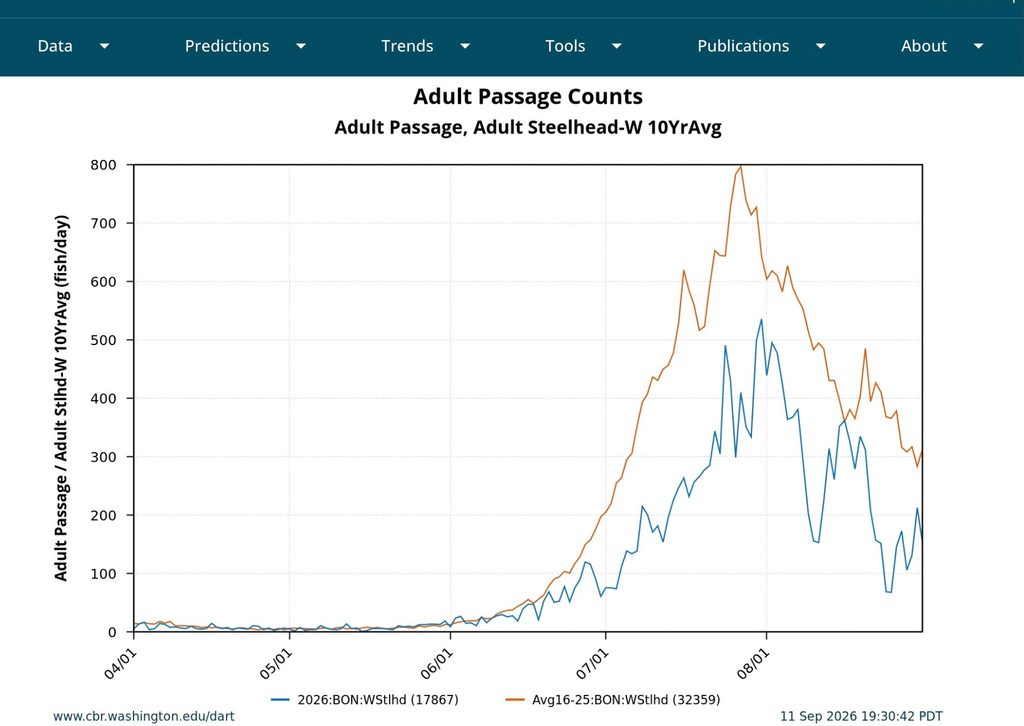
The gap between previous years and the current low return doesn’t seem too extreme by this comparison as 2026 is about 53% of the current ten-year average. The state agencies are comfortable with this. The agencies manage by this graph as it feels all the world like things are okay. We should not be comfortable with this as we are being led down the winding path of the shifting baseline.
The next graph displays the 2026 wild steelhead return compared with the highest ten-year average which occurred from 2001-2010. You can see the extent of loss by comparing ten-year averages over time.

There is no way steelheaders should stand for these sorts of inch-by-inch, yard by yard losses. If you want to be able to teach your kids to steelhead fish, and get in a few more trips yourself, then it is time to spend more of the offseason fighting than fishing.
I have begun drafting an angler’s workbook of sorts – and I hope that by winter’s arrival you will be in a fighting mood to crack it open. Coming soon.
Nearly five times the number of wild steelhead in 2026 passed Bonneville on average each year during that decade!
Thanks for reading.
David Moskowitz is an Oregon-based wild fish advocate. He earned his environmental law degree from Lewis & Clark in 1990, and worked for many impactful conservation organizations. He cofounded the Deschutes River Alliance in 2013 to help protect his home waters, serving as DRA’s first executive director. David was Conservation Angler’s chief executive for nearly a decade. David’s family enjoys gardening, river trips and live bluegrass. He is most proud of passing on a passion for community involvement and the outdoors to his children.