
For a long time, now, I’ve been thinking of a story I heard about two men who visit the Museum of Modern Art, right in the heart of Manhattan. The island of concrete where there’s not a trout stream for hours and hours. Just a sea of humanity.
The first man is someone I’ve probably seen before during my own visits. He’s in a hurry, ticking all the boxes of seeing New York City. The museum is just one item he’s budgeted into his family schedule—two hours to see the Museum of Modern Art. He rides up the escalator into a curated room clearly designed for quiet contemplation.
There, he confronts what could best be described as a piece of modern art: a portrait-style, large rectangle made of three primary colors. The base is white, unpainted canvas. Above it sits a blue box, and below, the blue fades into black.
From a distance, it looks deceptively simple. The man glances at it and judges instantly. ”My kid could have made this.” “This belongs on my refrigerator.” “I can’t believe this is in the Museum of Modern Art.” He dismisses the piece for its simplicity, thinking with just a little practice, he could have done better.
Then the thought bubble appears above his head: ”Where’s the food court?”
The second man has clearly traveled to get here and has used the occasion to dress with care. Instead of white socks and jean shorts, he wears his best trousers. He’s donned a well-used but fine wool sports coat and a matching hat—no tags—which his wife, now deceased, bought him years ago on their anniversary.
He pays his admission, moves past the school children and the noise, and rides up the same escalator to the same quiet room. He stands before the exact same portrait.
And as he looks at it, he just stares, solemn and still.
Perhaps there’s a tear forming. Perhaps it’s just him adjusting to the room. But without expression, he consumes this piece of art.
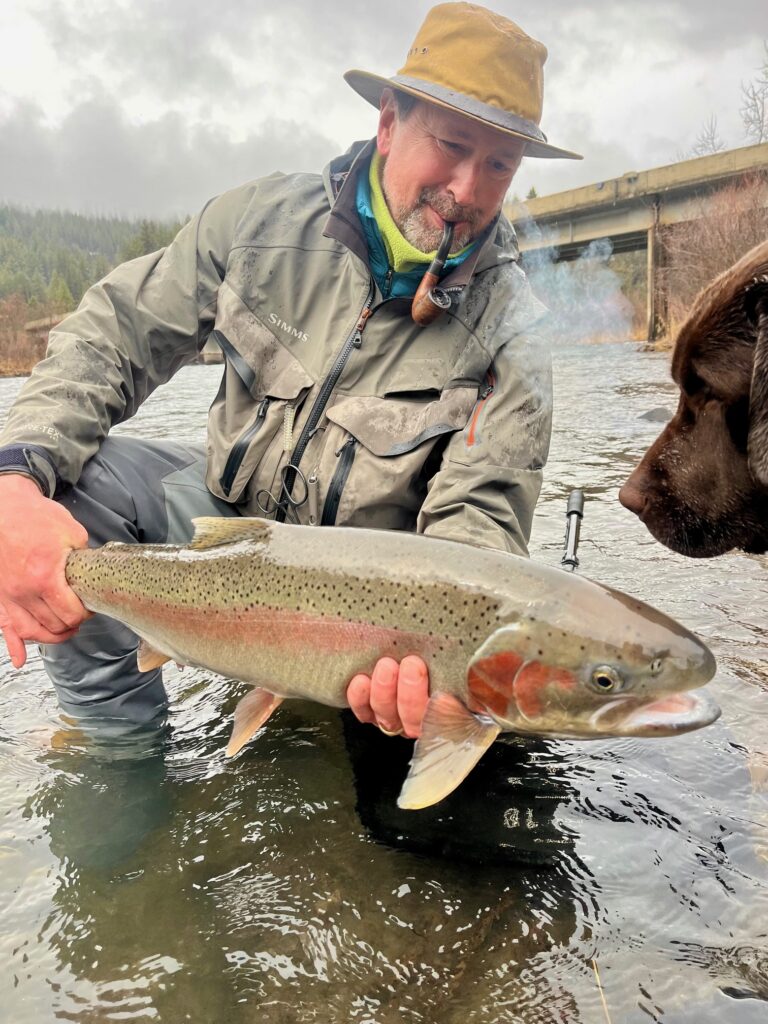
In my life, I have been both men.
When I think of the thread constantly being pulled through my life—the pursuit of adventure outdoors with a fly rod in hand—I hope my life is moving more toward becoming the second man than the first.
The act of fly fishing is, on its surface, entirely selfish. There’s no practical reason to do it. The end result might seem to be the ultimate thought of man overcoming nature: this small creature placed here, and I will bend it to my human will, make it take a fly. Upon my decision, I will either kill this fish and eat it, or show an act of mercy and let it go.
It can’t be that hard, right? If I just had the right gear, the right technique, if I just knew a little more about what the fish was eating or which fly might work… even a child with a Mickey Mouse rod from Walmart can reel in a fish.
And so the pursuit of a fly fisherman evolves—from having that first experience as a young person, often with a grandparent or parent on that one afternoon you’ll never forget, into an interest: learning to fly cast, learning to tie a knot. Then it becomes a hobby, which is where it remains for most people. They catch fish when they can, maybe a week in summer, perhaps a couple of afternoons in fall. It stays a hobby, an interest. On special birthdays or occasions, a new piece of equipment is assembled with great anticipation for that annual trip to Montana. It’s wonderful because it was a tradition from childhood. The cast has improved, and the chosen lodge is known
for having very willing trout.
For some of us, though, we bypass the hobby stage entirely, heading straight to lifestyle. We organize our lives around the pursuit—not only of trout, but then salmon, then saltwater species, and then, in my opinion, the grandest fish of them all: the Northwest steelhead.
Our lives become organized into compartments. The professional life. The family life. Perhaps church life. Sports interests and television watching. Life as a son or father. Games to attend, tasks to complete, savings accounts to manage. Yards to mow and maintain, kitchens to remodel.
And then, separate from all else, there is life as a fly fisherman.
When you’ve moved from hobby to passion to lifestyle, you learn quickly not to combine these worlds. You want your lives separate, not together, because you don’t want to harm fly fishing with the rest of life. It stands on a much higher pedestal.
For those who make it a lifestyle, we quickly learn that it’s not about fishing at all. It’s not about the act of catching a fish. This is hard for others to believe. It’s even harder for first-time non-fishers to understand why we don’t kill every fish. They ask with confusion: “You throw them back?” There is no violence in fly fishing- no throwing.
We learn that fly fishing is far more a metaphor for the pursuit of something in life that might or might not be attainable. To go fly fishing requires preparation, planning, and practice. Hopefully, all of that transforms into a level of mastery. And the moment one steps into the water, a master fly fisher becomes someone who can adjust and control the line as it’s presented to a fish.
About 120 years ago, America experienced a revolution that sparked both the American and international debate between conservation and environmentalism. John Muir and the creation of the Sierra Club stood on one side; Gifford Pinchot and the establishment of the Forest Service on the other. In today’s terms, one philosophy says “don’t touch it at all,” while the other advocates “manage, protect, restore.”
Through the following decades, humanity believed we could bend nature to our will. We could harness a river for electricity, then simply create hatcheries to grow more fish because we assumed that a fish is a fish is a fish. We thought we could control nature—shoot everything and kill it, and it would obviously regenerate.
These thoughts led to tremendous failures that we now recognize. But they also yielded tremendous successes. I always tell people not to judge their grandparents. They didn’t necessarily know what they were doing right or wrong by today’s standards. They fought in two world wars. They saved legions of waterfowl and returned billions of trout, steelhead, and salmon to the water.
I really only know about waterfowl and fish that take flies, and a little about well-behaved gun dogs and horses. But when you spend your time with those four types of creatures, you learn over time that you cannot control nature.
In fact, when I stand in a river with a fly rod in hand, I’ve come to realize I am the only element that doesn’t belong there. The rocks have existed since time immemorial. The trees have been there since their seeds were last blown in from the Pacific Ocean centuries ago. The dragonfly, the pine needle, the caddis drying its wings on the river’s surface, the otter that might scare everything away if it ventures closer, the trail where I spotted a bear a year ago—all remind me that I’m the thing that doesn’t belong. I am the predator. I am there to take.

The ethic of fly fishing today focuses on the art of catching a fish, reviving it, and gently releasing it. This practice might fuel ethical debates for the next 120 years, but it is what we do. People who don’t understand ask: “You spent countless hours practicing, reading, collecting gear, driving, camping, standing in rain and snow, all to catch a fish you’re going to release?” The question itself makes you wonder if these people, sitting in that museum in New York, wouldn’t be asking,
“Where’s the food court?”
The truth is that fly fishing is the art of pursuit, not capture. When we stand in a river, bathed in humility, realizing we don’t belong there but can be present, and we take a moment with our fly rod tucked under our arm and our hands warming in our coat pockets, just observing the water—noticing every detail from a floating leaf to the song of a bird, the water temperature, its depth, whether sunlight has touched the surface—it fills us with something you can experience only in retreat.
You realize that the river, this scene, is doing something to you.
It’s not about bending nature to your will; it’s about allowing this experience to transform you. Why did the second man in the museum grow tearful looking at three colors? Because something resonated deep in his soul. A memory triggered. A thought awakened. Loss remembered. Humility.
Gratitude for being alive. The ability to choose to enter the museum, walk up to that room, navigate through all the hurried people, and allow a piece of art to read him.
This is the same act performed by those who fly fish as a lifestyle. It defies logical explanation. Words struggle to capture the rolling conundrum of a fly fishing adventure, but you’ll notice that people who excel at it are generally quiet, contemplative, and moved more by the act itself than by success.
Quite often, I take out first-timers. If there’s room, I’ll find a piece of uninterrupted river. I’ll place my fly rod under my arm, fold my hands, and stare at the water.
To the uninitiated, this is maddening. They wonder, why don’t I get in and bend nature to my will.
“Why aren’t you fishing?”
I always answer with a smile, a respectful nod, perhaps a tip of the hat, and sometimes, just loud enough that they might hear, I say: “I am.”
I’ve been fortunate in my life to have met most of my fly-fishing heroes, the true masters of the sport—the Picassos, the Monets, the Lichtensteins. While at the very top, their casting styles may be slightly individual, their fundamentals are so sound that the old adage proves true: they’ve done it right for so long, it’s difficult for them to do it wrong.
I’ve noticed that the very best in the world aren’t frantically self-promoting on Instagram, offering abundant high-fives, or displaying their phones to show the catch of the week.
I’ve observed five things about these masters. First is their humility; you never hear them speak with the letter “I.” Second, the masters I’ve met are people of faith. Third, they all maintain relationships with sporting dogs and families. While they’ll gladly share what their children are doing, they really want to talk about the dogs—what fine retrievers they were, and the day a particular dog saved them.
Fourth—perhaps because anyone who does this long enough has experienced tough days when this becomes the best part—the masters all know about food: how to prepare it, and can wax poetic about lamb in Patagonia. Fifth, what truly distinguishes a master from a hobbyist is continual curiosity. There’s always something more to learn.
The Pacific Ocean crashed and created an effervescent mist about three hundred yards from a pool where I once stood, assisting a man who was a master, who became my friend, and who was then ninety-three years old. We were fishing a tiny river right on the ocean—the first pool of freshwater for salmon. He needed me to help him into the pool, gripping my shoulder tightly as he pointed with his fly rod: “Over there, young man. Take me over there.”
As soon as he was ankle-deep in water, he released my shoulder and moved around that pool like a second-grader on playground equipment at recess. I watched this master place his rod under his arm, slip his hands into his coat pockets, and stare at the water. Without exaggeration, we could see fifty salmon in the pool.
I observed him, knowing better than to ask, “When are you going to fish?” I watched this master make what many consider one of the finest roll casts known, and with just a few casts, convince his targeted fish to take the fly. I witnessed a ninety-three-year-old man who could barely walk run up and down this pool, kneel down to release his fish, then look at me with a sparkle in his eye and a wink, saying, “It’s really not that hard.”
I will tell you, it is that hard. Mastery takes time. From being quiet and maintaining an attitude of learning rather than knowing, I’ve discovered that in fly fishing, I remain a journeyman. I have not yet become a master. Perhaps in twenty years, my cast might achieve such consistency, my knowledge might expand that much, my respect might grow deeper for the fact that I don’t belong in these waters.
But, should I find myself on an escalator deep in Manhattan, surrounded by loud schoolchildren being hushed by chaperones as they reach the first gallery, attempting to comprehend something incomprehensible called modern art, I hope I’ll be the kind of man who simply stares without judgment—who allows the art to read me and ask myself: Why am I responding this way? What do I
have to learn?