

Yes, that’s exactly what I’m saying. At least insofar as we’re talking a standard Skagit head with a floating body and a chunk of T-whatever looped to the end. “Heresy!” you say. Maybe. Maybe not. In fact, you might be better off using a full-sinking Scandi line when fishing for winter steelhead on the Skagit and you may want to re-think that heavily weighted Intruder tied on a shank while you’re at it. “Blasphemy!” you say. Maybe so. But read on before you make up your mind. I can be persuasive.
Structure
A straight line is the shortest distance between two points. In casting and fishing terms, a straight line is also a tight line. If you have a straight-line connection to your fly, you’ve eliminated slack in the system. You’re in full contact with your fly. You feel everything—every little tick, pluck or pull. Slowly raise your rod, and you’re instantly into a fish that has inhaled your fly before he has a chance to spit it out.
A full-sinking line—e.g., a Scandinavian-style triple-density shooting head—is designed for just such an occasion. Pick your casting angle, make the cast, and let the line do the rest. Little to no mending is required. As the entire line sinks beneath the fastest layer of current at the top of the water column, you get the slowest swing possible, provided you select a casting angle that is appropriate for the speed of current. A full-sinking line will also find its depth and maintain that depth throughout the swing—an important consideration when the water is cold, and a fish will often move laterally to take a fly, but may be reluctant to rise up in the water column to eat the same fly.
Consider the average Skagit line with a floating head and a length of T-11. A fast-sinking tip is suspended from floating line that may be the equivalent of a double-taper 12-weight line in thickness. A Skagit system with a short, ultra-thick floating head and a lead-eyed fly more closely resembles a jig fished beneath a float. Right-angle nymphing also comes to mind. This set-up is the antithesis of a straight-line connection to the fly. If you want to convert those bites to hook-ups, a full-sinking shooting head achieves a direct connection to the fly in addition to a slower swing.
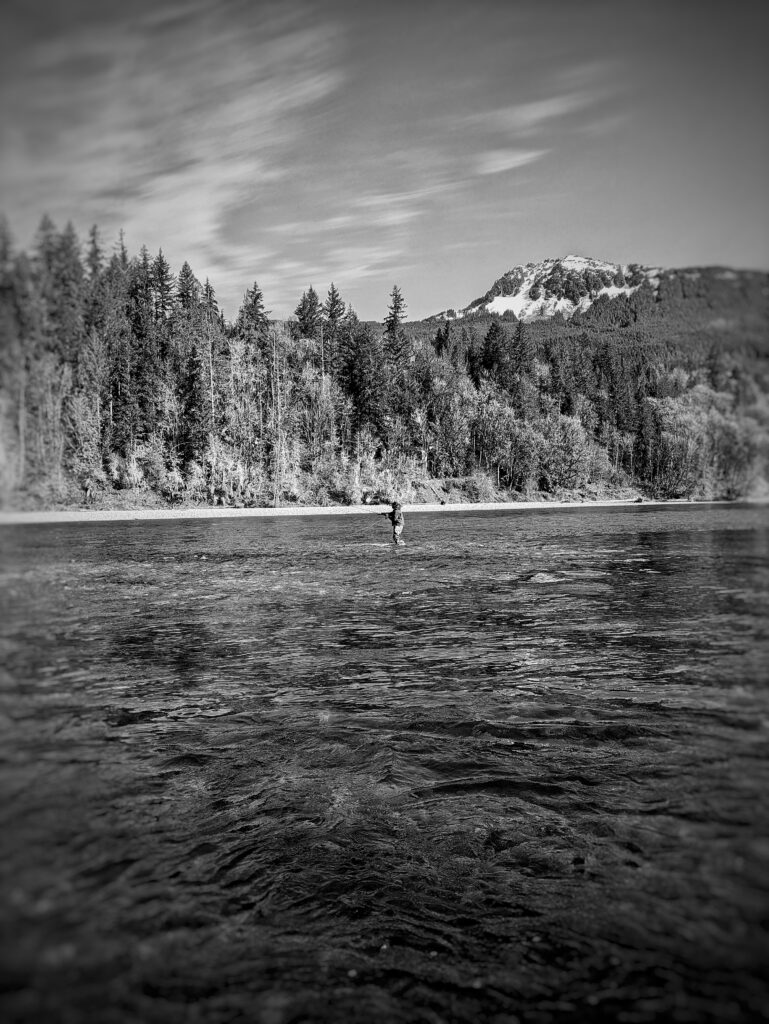
So what is the mitigating factor that we’ve not yet mentioned? Structure. Structure. Structure. The Skagit river is not pocket water. The river does not require you to constantly dodge large boulders and blow-downs with your fly in order to fish a deep slot on the other side of these obstructions. A typical winter run on the Skagit and dozens of other rivers with similar structure is among the purest swings in all of steelhead fishing. A line that allows a tight connection to the fly and keeps that fly at the proper depth throughout the swing is a singular advantage. Cue up the full-sinking shooting head.

The Line
Just so you don’t think this article is a hit piece on Skagit lines, if you’re fishing those deep slots and smaller pockets and you need to get your fly down quickly, then a Skagit line with a floating head is the perfect tool for the job. I have not forgotten that Skagit lines are also available in sinking versions. A F/I/3 Skagit head (Float/Intermediate/Sink 3) with the appropriate sinking tip (say, 10 feet of T-8) achieves a nice straight-line connection to the fly, while also allowing you to fish your fly as close to the bank as possible. A length of heavier T-whatever may actually be counterproductive, if you start hanging up on the bottom before you get to the good stuff on the inside.
As mentioned above, full-sinking Scandi lines are another excellent option for winter steelhead on large rivers. I have fished the Skagit river on several occasions as well as the other famous “S rivers” in Puget Sound (when they were open), but my bread-and-butter fishing is the Atlantic salmon rivers of eastern Canada. My favorite rivers—Restigouche, Matapedia, Cascapedia—feature holding water that is very similar during the early season to rivers like the Skagit. There are some important differences—namely the fish—but the holding water and the approach to that water is broadly similar. My most productive fly line when the water is at medium to medium-high levels is a H/I/2 (Hover/Intermediate/Sink 2) shooting head that measures anywhere from 41 to 44 feet in length. You don’t need a sinking tip with a triple-density Scandi head. Loop it to your shooting line, add a leader to the other end, and you’re in business.
Floating Scandi lines are popular in North America with size #4-#8 flies for summer steelhead and Atlantic salmon. This popularity has led to the misconception that Scandi lines should be used with smaller flies and surface presentations. If you travel to Norway during the first half of the season (June 1-July 15), you’ll find that anglers from Norway, Sweden, Germany and the U.K. are far more likely to be fishing a sinking Scandi head. In high water during the early season, they may be casting tube flies that weigh more than any Intruder and using sinking lines that sink faster and deeper than any standard Skagit line. The most popular rod in Scandinavia during the first half of the season is a 15-foot for a 10-weight. To complete the set-up, most anglers use a 41-foot shooting head that weighs in the neighborhood of 700 grains.
Waterborne casts—snap-t, double spey, Perry poke—are popular with Skagit lines. By contrast, European anglers use a single spey or a snake roll with sinking Scandi lines. There are multiple ways to maintain a straight-line connection with either system, highlighted by the importance of incorporating multi-density heads with each section sinking more quickly than the last section to eliminate any potential sag in the line.
As long as you reduce the grain weight of the head, you may find that you are able to make touch-and-go casts (single spey, snake roll) with a sinking Skagit head. Just because it’s a Skagit head, doesn’t mean that you have to make waterborne casts. The same is true for a Scandi head. You can make every waterborne cast with a Scandi head. Scandi lines are generally longer than Skagit lines to facilitate grabbing an anchor with touch-and-go casts. Choose the line system that matches your preferred casting style and delivers your payload (the fly) with maximum efficiency and a minimum of effort.
My preferred fly line for spring fishing is either a H-I-2 (Hover/Intermediate/Sink 2) or an I-2-3 (Intermediate/Sink 2/Sink 3). Full-sinking Scandi heads find their depth and stay there once the sink rate is equalized by the strength of the current. As the entire line sinks, any weight in the fly is used to keep the fly at or slightly deeper than the tip of the fly line. Heavily weighted flies are seldom if ever necessary. As mentioned, heavily weighted flies tend to hang up on the inside. They are also difficult to cast, requiring more mass in the fly line to deliver its payload. If you remove weight in the fly, you can also reduce the number of grains in the fly line to deliver that fly. If you multiply the number of casts that you make in a day by the number of grains that you have removed from the line, the energy savings can be substantial.
Another advantage to full-sinking shooting heads is the ability to use longer leaders in clear water. We’ve always been told that we need to keep the leader short so that the fly sinks at the same rate as the fly line. Many anglers accept this rule as fact. As a general guideline it works, but the rule presents a problem when the water is clear and underwater visibility is exceptional. In these conditions I use longer leaders to create separation between the fly and the end of my fly line. I don’t want the end of the fly line to divert attention away from the fly or spook the fish. These leaders are typically 8 feet to 11 feet in length and tied with fluorocarbon to facilitate the sink rate.
A reach cast (aerial mend upstream) allows a full-sinking line and the fly to sink before you come tight to your fly. When fishing a longer leader with a full-sinking line, it’s important to get some slack into the system to set up the line and the fly for the swing. There are multiple ways to introduce slack for some extra sink time. These include the reach cast, stepping downstream, slowly dropping your rod once the line is on the water or any combination of these techniques. When a full-sinking line and the fly are given time to sink before the swing, the pull on the line and leader is exerted from lower in the water column during the swing itself compared to a floating head and a standard sinking tip. The line and the fly find the proper depth and maintain that depth throughout the swing.
The Fly
Richard Waddington designed the Waddington shank in the 1940s to solve the problem of leverage when fishing large single hooks for Atlantic salmon. The introduction of the Waddington shank coincided with the development of small treble hooks, which provided improved landing rates compared to large single hooks. Tube flies, introduced in 1932 by Alexander Wanless, have replaced Waddington shanks as the platform of choice for Atlantic salmon fishing. If past is prologue, a similar transition from shanks to tubes will occur in steelhead fishing.
The many benefits of tube flies are impossible to ignore. Tube flies eliminate the leverage problem as well as or better than shanks. In the U.K., silicone junction tubing is a popular way to connect the hook to the tube. In Scandinavia, many anglers insert the hook directly into the plastic tube on which the fly is tied. When a salmon takes the fly, the hook releases from the tube, and the angler plays the fish on just the hook while the tube slides harmlessly up the leader.
Richard Waddington incorporated the treble hook into the design of the fly pattern. He tied his flies in-the-round, leaving the treble hook exposed to imitate the tail of a baitfish. With treble hooks banned in many locations, Atlantic salmon anglers have made the transition to double hooks and more recently to single hooks. In Canada, treble hooks are banned and double hooks can only be used in Quebec. Treble hooks, still popular in Scandinavia and Iceland, allow the angler to tie tube flies without consideration for the orientation of the hook. With double hooks and especially with single hooks, the orientation of the hook becomes an important consideration. Silicone junction tubing placed at the end of plastic, aluminum and copper tubes allows the hook to orient securely in the preferred position—usually straight up or straight down. The Scandinavian practice of inserting the hook directly into the plastic tube on which the fly is tied achieves the same end.
Using wire to secure a single hook to a shank does not confer the same advantages. If you watch underwater videos on YouTube or social media of Intruder-style flies tied on shanks, the hook frequently rides on its side. If a steelhead eats your fly, the angler has a 50/50 chance of success with the hook riding on its side. Success depends on which side of the mouth the fish takes the fly and on which side the hook is pointing. That’s a lot of uncertainty in a game not known for its predictability. By contrast, a tube fly offers a secure point of contact between the hook and tube as well as complete control over the orientation of the hook. If you do make contact with a fish, it’s nice to know that the orientation of the hook maximizes the chance of bringing that fish to hand.
Tying flies on tubes is also easier than tying on shanks. If you tie on plastic tubes, you can trim the length of the tube at either end with your scissors after you tie the fly. As a result, you can decide where to locate the hook once you’ve completed the fly. With shanked flies, the length of the wire that secures the hook is locked in before you tie the fly. Easy is good, particularly when that third Double Hazy IPA hits the bloodstream.
With a tube, you can slide on a conehead before you tie in the wing to lift and support the materials and then add another conehead (or not) to assure that the fly rides horizontally in the water column. I have some exceedingly anal friends (we have a support group in case you’d like to join), who weigh the hook and the conehead on a grain scale to make sure that they balance. There is no detail too small to feed the obsession. Fishing season is short, after all, and fly-tying season is long.
Finally, a tube fly requires no knot at the front of the fly. The leader is fully protected within the tube, and the knot to secure the hook is also protected inside the tube or the junction tubing. The knot itself cannot rotate around the eye of the hook, assuring a straight pull on the hook 100% of the time. As the tube releases from the hook and slides up the leader, the fly cannot introduce leverage when playing a steelhead or a salmon. If the hook is damaged on a rock, slide the tube up the leader, tie on a new hook and you’re back in business.

A Couple of Predictions
The fly line is the most important tool in our tool kit. The fly is important too, but only if we can deliver that fly with consistent turnover and present it at the right depth and at the right speed. The fly line trumps the fly pattern in this relationship. A steelhead or a salmon will take a variety of different fly patterns, but first they have to see it and then you have to make them want to eat it.
A straight-line connection to the fly eliminates any slack in the system and assures full contact with the fly. A triple-density Scandi head or a multi-density Skagit head is the right tool for the job, provided you are not presented with a heavy diet of pocket water or large boulders and blow-downs on which a full-sinking line might hang up.
The primary advantage of touch-and-go casts (single spey, snake roll) when compared to waterborne casts (snap-t, double spey) is efficiency. Touch-and-go casts are faster to execute and travel farther through the air. Distance as a measure of casting efficiency is overrated. Most speycasters are guilty of “over-casting” at some point during the season. The reduced amount of time and effort that it takes to execute a single spey or a snake roll is far more important than any other measure of efficiency. If you are fishing a stretch of water that is 400 yards long, you’ll reach the end of that holding water more quickly with touch-and-go casts. The time that you save means that you can fish more water in a day. If the Mother Of All Spey Casts (the single spey) is not part of your repertoire, you may be missing out.
Any obituary of flies tied on shanks for steelhead fishing is premature. The same cannot be said regarding shanks for Atlantic salmon fishing. The Waddington shank, invented in the U.K. for Atlantic salmon, has completely disappeared as a commercial entity due to the popularity of tube flies. I have fished all over Europe for Atlantic salmon. I’ve never seen even a single fly tied on a shank. The many advantages of tube flies have rendered the shank obsolete for the game that I am most familiar with.
Here are two predictions before I sign off. Flies tied on shanks for steelhead will suffer the same fate that flies tied on Waddington shanks endured for Atlantic salmon, which is to say that they will be replaced by tube flies. Secondly, the terms “Skagit lines” and “Scandi lines” will fall out of favor. I’m not saying that Skagit lines or Scandi lines will disappear. I’m referring only to the nomenclature. We may end up simply calling them “shooting heads” for that is what they are. Newer “hybrid” lines are available now that blur the distinction between a Skagit head and a Scandi head. These hybrid lines perform equally well with touch-and-go casts and with waterborne casts. This refined combination may be where many of us end up as we streamline our approach to swinging flies for steelhead and salmon.