
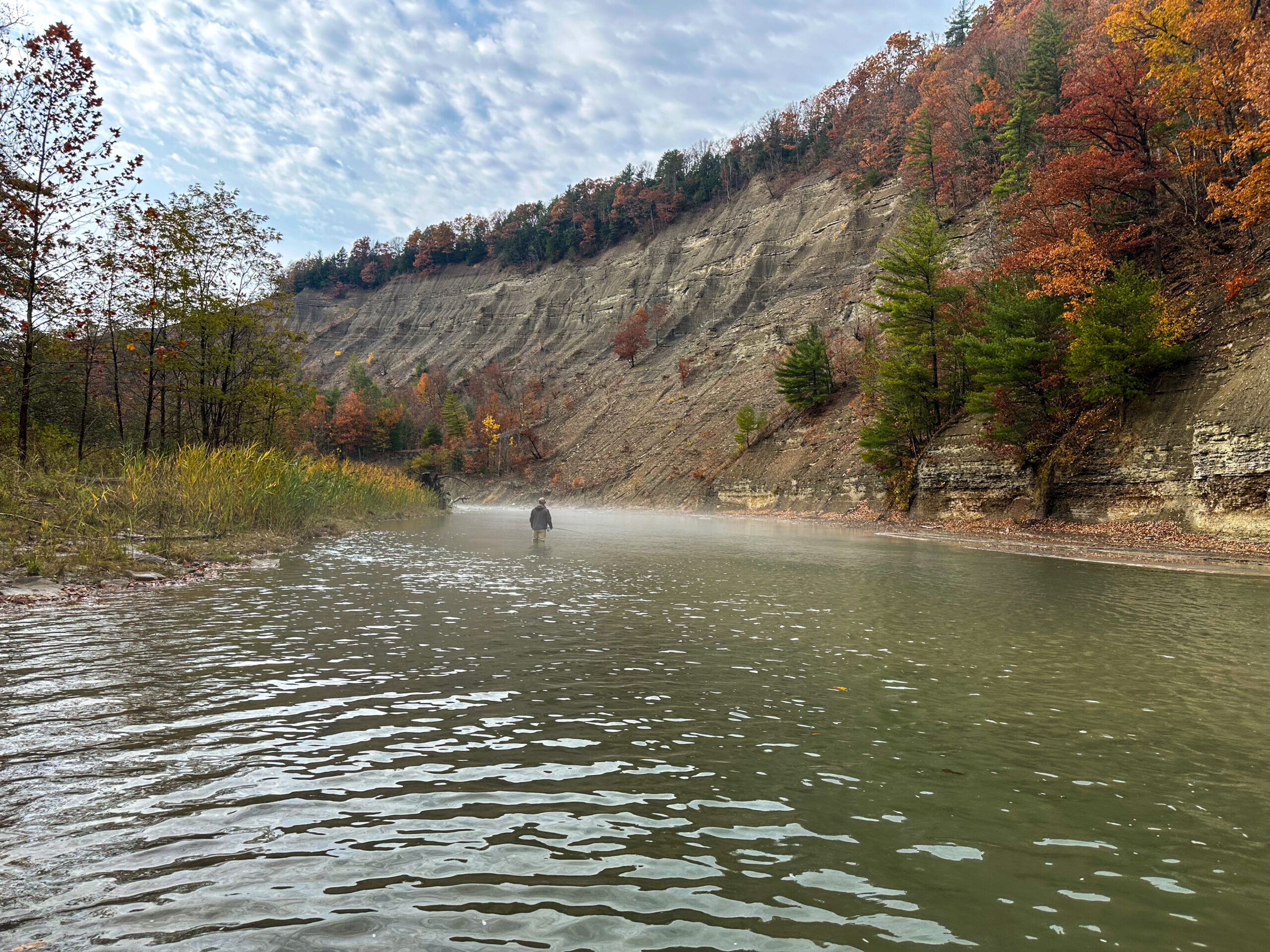
As spey anglers, we are often most focused on the cast. And why not, spey casting is an enjoyable, engaging process. Sure, it can be frustrating, but those drawn to this sport are typically energized by the challenge as well as the tactical advantage of a cast that allows for ultimate efficiency in changing direction even in the tightest of casting positions.
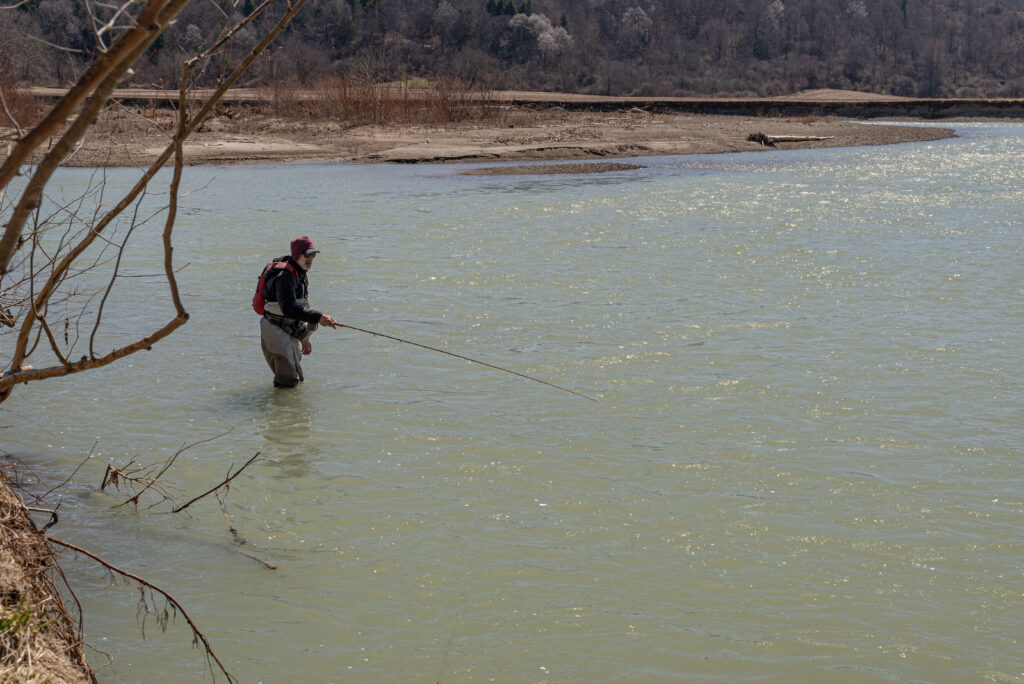
But at its core the act of spey fishing is about purposely and even artfully covering the water. When it is all working together, the cast is the beginning piece in the puzzle of properly presenting the fly while considering the variables of the water conditions, holding structure, and personal preference. However, the concept of melding a good cast with effectively fishing the fly can be as difficult to master as the cast itself. From guiding spey anglers of all levels I have observed that there tends to be a separation between the cast and the swing for less experienced anglers. Beginning to intermediate spey anglers seem to put extra energy into making the cast while letting up on a continued focus of presentation and complete coverage of the water.
The two acts should not be distinct. The casting angle, length and proper turnover all impact the effectiveness of presentation. But where some anglers seem to struggle the most is the regular cadence of completely covering a pool or run from top to bottom. The swing of the fly plays upon a fish’s instinctive response to hunt and chase prey. And applies to both migratory and resident fish. One of the main advantages of spey fishing is covering a lot of water in search of an active fish that can be enticed by the fleeing movement of the fly. Often, I need to remind clients to keep moving with each cast and to imagine the pool and run as a big grid while covering a small incremental portion with each cast.
I believe the swing works best when the fly takes the fish by surprise. By not moving at pace between casts this key element of the presentation can be lost. This also occurs when the steps are too short between casts. I prefer to vary the distance in my steps based on water conditions. In clear water where a fish can see the fly from a greater distance, longer steps between the cast enhance the chance of triggering a response. In highly stained water the distance between casts is reduced to the approximately the length of visibility. I’ll also consider water temperature when determining step length between each cast with an assumption that fish may move a further distance to the fly in optimum temperatures as opposed to cold water. My preference is to step down right after making the cast while setting up the swing. Movement at this time can assist with depth control when using a sunk fly or sink tip as the fly sinks freely when not under tension while stepping down. Further depth and speed can be controlled by casting angle and mending.
Water availability also has impact on my thought process when covering possible holding areas. Days of heavier fishing pressure can result in less open water to fish or fishing behind other anglers. This is an occasional occurrence on my more heavily pressured home waters. The approach now may be more methodical when open water is limited by possibly making two casts from one position but making sure to greatly vary the depth or speed of the two casts. And when covering the same pool or run with successive passes, the best approach is to vary both the fly and presentation to provide a different look aimed at getting a response from a fish that was not impressed with an earlier attempt.
In putting the process together, water coverage begins with a repeatable and consistent cast. Consistent casts with straight turnover at a desired distance and angle needs to be second nature. Focus then shifts to moving at a desired regular pace. And don’t forget about stealth. The chance of success increases when fish are not aware of your presence. Stealth will be of a higher premium in smaller more intimate settings and in low water conditions. Wade carefully and not too deep when the first one through a pool. Also, attempt to make stealthy casts. Touch and go casts create less water disturbance and when using sustained anchor casts, take a little off the sweep and keep it as close to the casting position as possible.
While I stress a thoughtful systematic approach for covering most water, there is never one size fits all in fishing. Structural elements within a pool or run, some obvious and others nearly hidden, may require variations to the simple cast and step approach. Being more deliberate when casting in proximity of structure that has an above average chance of attracting and holding fish can have its benefits.
Soft water created by boulders and rocks within a pool or run typically provide a high percentage holding area. Sometimes a boulder will be visible but typically a boulder or series of large rocks create a disturbance on the surface. And in areas with multiple rocks and boulders, a series of disturbance will show on the surface. If no one is fishing right behind you or it’s my fishing partner moving at the same pace, I may slow the approach to the point of making a couple casts from the same position while varying each presentation. I may make one presentation by pointing at the fly showing it more broadside and then make another by pointing the rod out to give the fly a more upstream angle while slowing its swing. I can also vary casting angle or mending to change speed or depth. But after two or three casts I’ll continue to move downstream.
A type of water that I commonly encounter on my home rivers is a ledge in the bedrock or a distinct drop off. Ledges can typically be determined by the change in the water’s color. Also, making a mental note of ledges when the water is low can be valuable information. This type of water generally doesn’t require multiple casts from one position but rather a focus on accuracy and being more precise than simply laying out your longest cast. Both migratory and resident fish use the ledge/drop off for security or as a feeding location. This water is typically fished with a weighted fly that drops along the ledge. Place the cast right on the edge of the drop and allow the fly to sink before bringing it under tension to slowly pull away from the ledge. Another approach is to make the cast a little long onto the ledge and then lift the rod tip to pull the fly back to the drop while creating slack in the line. This allows the fly to sink quickly.
On many of the smaller waters where I pursue both migratory fish or resident trout and smallmouth bass, log jams along the bank create optimum holding structure. Accuracy is the key as dropping the fly right along the log sets up the ideal presentation. The fly sweeping and fleeing away creates a nearly irresistible offering for a fish positioned along the log.
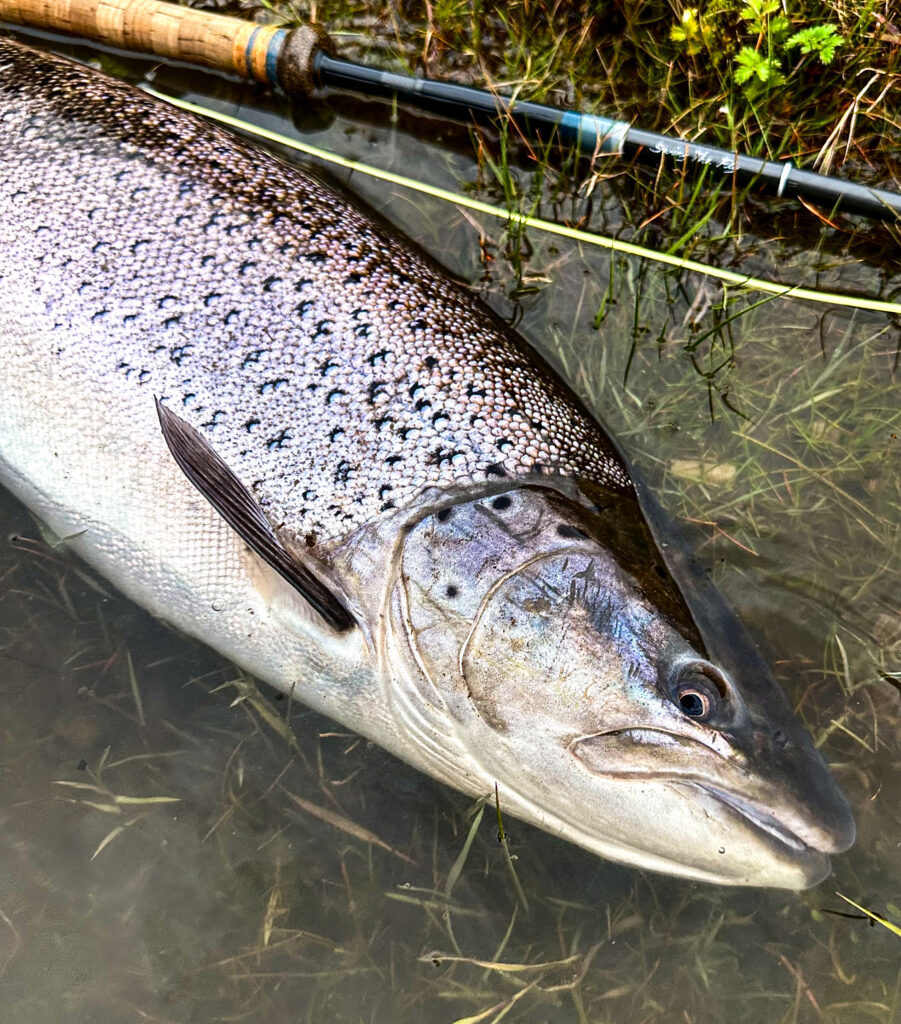
When fishing along log jams I often add a strip action to the fly for extra movement. This is a technique that I’ll also employ at times when covering bigger pools and runs. The strip approach involves incrementally retrieving the fly as it swings and is aimed at imparting more life into the fly or portraying bait that is struggling and vulnerable. But from a water coverage perspective consistency in the retrieve is the key to maintaining the gridded approach to the presentation. Varying the retrieve in terms of speed or length of strip after each step can result in water going uncovered. If a varied retrieve seems warranted, it is best to make two passes through the pool with different retrieves or make two casts from the same position with different retrieves.
Covering the water is not a concept that simply applies to main pools and runs but rather looking at a river in its entirety. Small pockets, slots, and troughs found within shallower areas often provide a resting or feeding area along with some security. I never pass by this type of water without at least a few casts. Setting up above the deeper water allows for the proper angle to swing the fly through. I may try a couple casts from each position varying the speed and depth. Covering this type of water may only require a handful of casts but consistently plying a fly in any area deep enough to hold a fish eventually pays off and often with a violent grab.
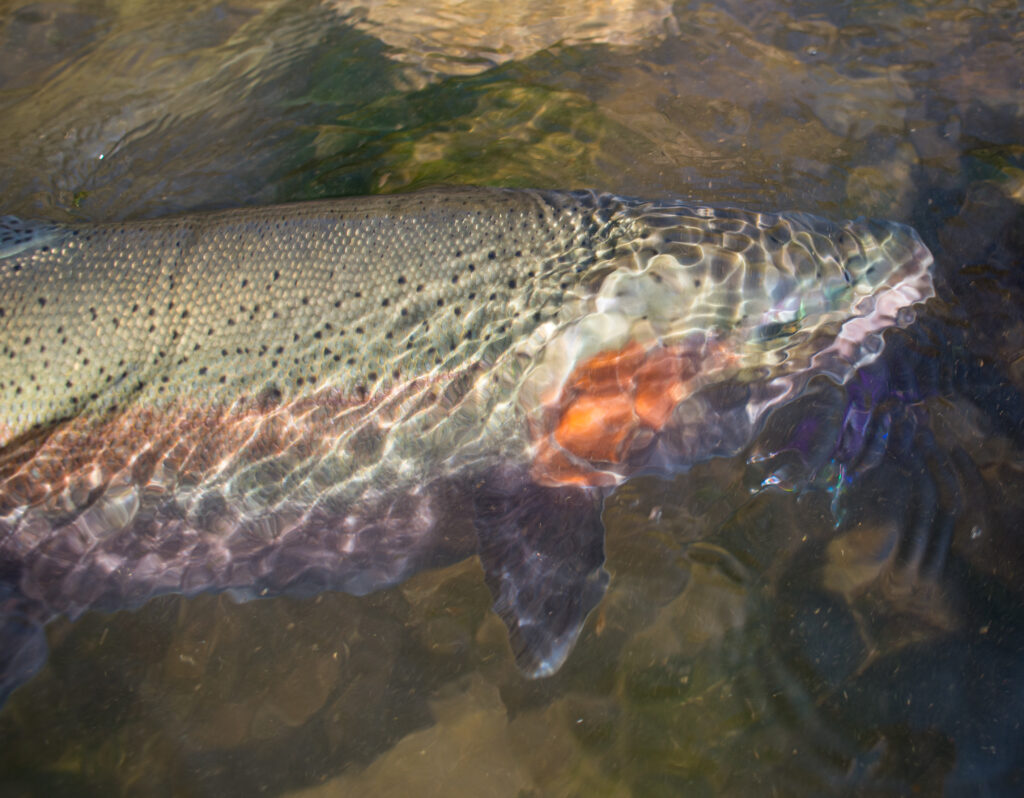
Of course, my cadence can be disrupted when I encounter a fish that shows or grabs the fly but doesn’t fully commit. I’ll typically plant my feet and make the same cast to see if the fish comes back. If there is no one fishing behind me, I’ll usually move up a few steps, change to a smaller more subtle fly and make the same distance cast again while beginning to work back down the pool or run. If the fish doesn’t react to the fly change it is usually changed back to the original pattern. I’ll also make a mental note of the spot to make sure I’m ready if I make a subsequent pass through the pool.
Sometimes the most effective approach to covering the water involves not moving at all. A few prime fishing spots come to mind where moving through the pool is impossible due to wading obstructions or wading depth. In this situation covering the pool can take the approach of varying the casting length from one position. Start with the shortest cast that allows the fly to swing and then lengthen it at regular intervals typically about two feet at a time until the pool is covered, or a maximum length cast is reached. Some pools like this also allow for a slight movement down river.
I have also encountered situations where it makes sense to stay put and not move down the run from a tactical perspective. If fish are visible and concentrated in a specific part of a run or pool, and ethically possible by not holding up other anglers in a rotation, staying in one spot to lay out multiple casts makes perfect sense. From that position variations to the length and angle of the cast, depth of presentation, and fly pattern can be used to mix it up in hopes of triggering a fish to take. The old adage of not leaving fish to find fish applies here.
Spey casting on its own is an enjoyable, captivating activity and more importantly the first step to proper fly presentation and complete water coverage. Consistency in the cast and presentation is at the very core of properly swinging the fly to be sure that any possible fish holding in the water being worked has an opportunity to see and react to the fly. Applying consistency is an art and an integral part of the Zen of spey fishing.
