“… What did they live on?” asked Alice, who always took a great interest in questions of eating and drinking. “They lived on treacle,” said the Dormouse, after thinking a minute or two.
~What The Dormouse Said
Language changes to keep up with the needs of its users. Yet, lately, it seems nomenclature stumbles to stay on pace with usage. I lay blame on the past hundred years of unprecedented acceleration of human development. For example, in the English language as spoken during Izaac Walton’s time, a fly – sometimes spelled ‘flye’, ‘fligh’, or ‘flygh’, as spelling was not yet standardized – was a commonly used blanket term for describing virtually all flying insects found about trout streams and much less specific than the taxonomic names we apply today. In Walton’s time artificial baits made from feathers and fur applied to a hook were fished as fraudulent bugs meant to vaguely simulate the general population of bugs (flies) found about the stream. And the act of applying materials to the hook, and the material list for a particular fly pattern, came to be known as a dressing, an apt descriptive term, as the hook is dressed with materials to create the fly.
As tackle advanced beyond just a pole and a string, windlasses (reels) and line guides allowed for the pursuit of bigger game. We began to see the development of feathered baits meant to simulate minnows and prawns, yet, the term fly stuck, regardless what the dressed bait was meant to suggest – and now there are many kinds of artificial flies. A great number of them had nothing to do with insects, and many, particularly those used in salmon and steelhead fishing, are actually lures, trigger baits not simulating any kind of life form.
In the past couple centuries flyfishing nomenclature came to common usage slowly, and fairly easy to understand even among casual practitioners of the game. Then came mass media in its various forms, able to reach vast numbers of ears and eyes simultaneously. This enabled entertainers, musicians, writers, and certainly advertisers, the power to change language and nomenclature, sometimes with a single stroke. In the opinion of some, this was not for the best, serving to actually downgrade useful terms that might stand better as touchstones connecting us through the ages. For example: the old term dressing seems to be morphing into recipe, meant to describe the material list for a fly pattern. Not losing any sleep over that, I’m merely a recorder of syntax, not the arbiter of terms.
I once had a regular client, we’ll call him Old Mike, a confirmed old-school neoclassicist holding a fairly hard opinion on the subject of flyfishing nomenclature. Old Mike offered this:
“Some fish-writer back in the 60s called a dressing a “recipe”, thinking it was cute, and damned if that didn’t get picked up and passed down. And now there’s so much Bro fishing crap the language is gone to hell, full of market-speak understandable only to perdigon whippers and bobber ploppers. A fly is dressed. Not baked. Any dude with the word recipe on his lips should be dressed – dressed in a flouncy flower print apron and hung by his shrunken petard.”
Old Mike was in the habit of delivering this type of proclamation deadpan. I’m not sure how serious he was. No matter. I sympathize with him, I really do. Though I think Mike’s prescribed punishment for loose usage somewhat harsh. And I doubt a shrunken petard would hold the full weight of a well-fed, hanging, fly tyer. Besides, I’m getting older, have given up dealing punishment, have learned to pick my battles, and prefer to spend precious time in gentler pursuits.
Dressings and Recipes do have a couple of obvious things in common. Both require a list of ingredients or materials. The end result of either process is meant to be eaten. Yet here’s an important difference between a recipe and a dressing: One is a yummy cake. The other a dangerous fraud that does not belong in a person’s mouth.
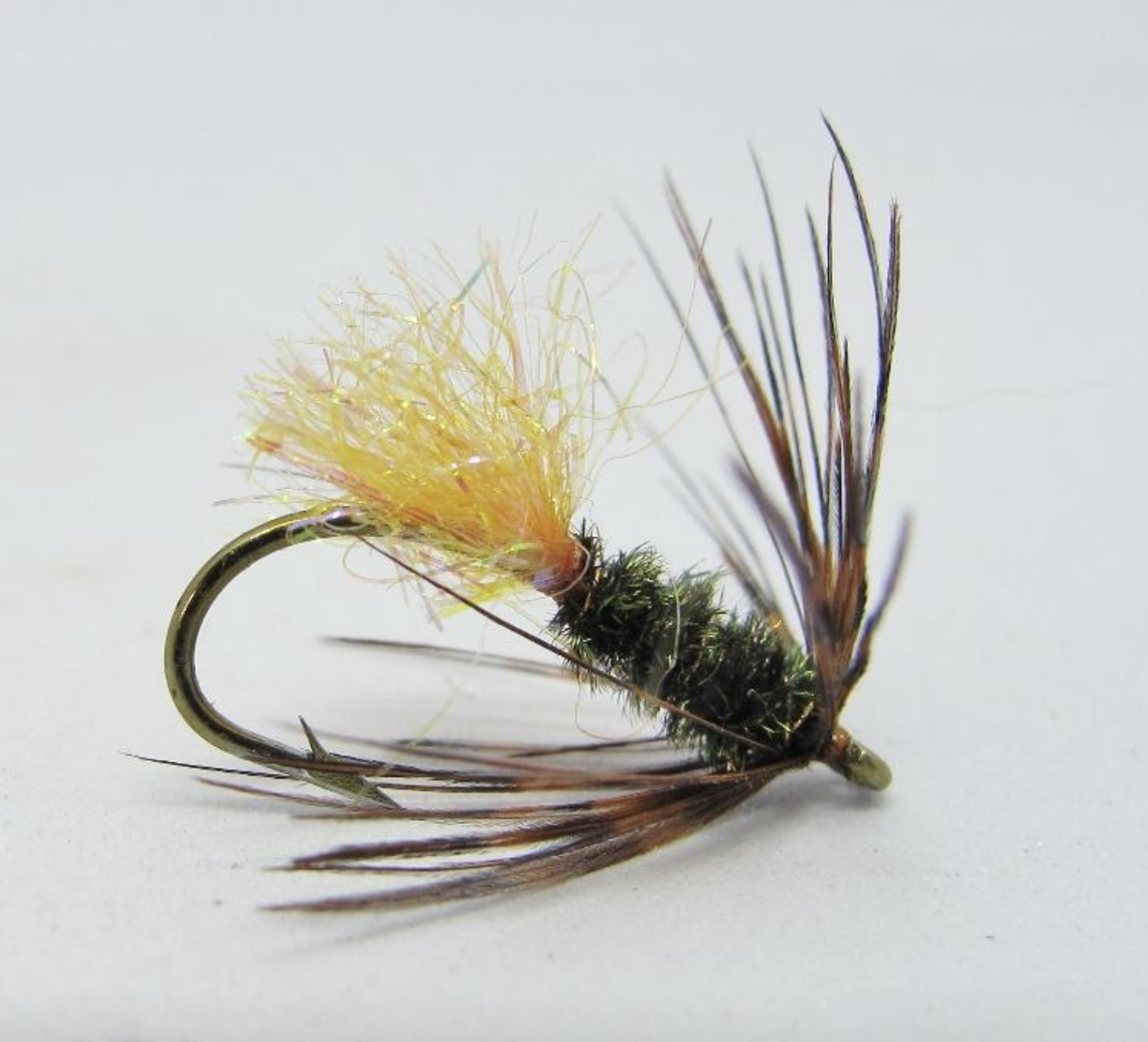
So to you who are chronic usage offenders I’d suffice it to illustrate the difference between a fly dressing and a recipe, giving the dressing for the useful Treacle Parkin fly, a spider native to the river dales of Yorkshire and southern Scotland, named after a favorite dessert native to that same region. Treacle parkin is a molasses cake made with oat flour. The originator of the fly is lost to history, and the general opinion is that the pattern is a variant of the Red Tag, an ancient pattern still popular in the U.K. and also effective on North American rivers. My guess is that the originator must have had a sweet day fishing the new variant – so sweet, he named the fly after his favorite dessert.
Here is the DRESSING for the fly: TREACLE PARKIN
Hook: #6-#14
Thread: Black (I like rust brown UNI 8/0)
Rib: copper wire
Tailing: The original calls for yellow wool crewel. At the time the original was created, wool crewel from your own sheep or your wife’s knitting basket was much easier to obtain in a world without automobiles or fly shops. We have the advantage of easy access to some worthy substitutes, such as floss, marabou or synthetic fibers. I like golden yellow Antron for this pattern. Red tailing for the Red Tag variant. (As with a recipe, some ingredients may be substituted in the dressing.)
Body: peacock herl
Hackle: brown badger (red-brown or brahma hen or brown partridge are good as well). When dressing larger versions, #6-#10, I add a couple turns of red-brown pheasant rump or marabou tip behind the front collar.
In the region of its birth the Treacle Parkin is known as a good grayling pattern as well as a trout fly. I’ve found this one to be a worthwhile swung-fly on our side of the pond. The not-too-flashy Treacle Parkin can be a worthwhile attractor pattern for prospecting, and a wee version can be good during caddis hatches. In larger sizes it fishes well for low-water steelhead and sea-run cutthroat. Most often, I fish the Treacle Parkin tied in #6 for swinging over both steelhead and larger trout. Any number of colors might be applied in lieu of yellow or red to create the color spot tailing. Try blue, pink, chartreuse or claret.
We see there is quite a difference between the Treacle Parkin dressing, above, and a plate of treacle parkin made from a recipe, below.
Here’s the RECIPE for the cake: TREACLE PARKIN
Parkin, made from oat flour, was a staple in medieval Yorkshire and Scotland; a sweetened version made with honey. Treacle parkin became popular with the introduction of molasses (treacle) from the New World used as the sweetener. The cake has a sticky, chewy, satisfying texture, a robust flavor, and keeps for long periods getting better as it ages. It is delicious and never ages for long at our house.
Ingredients
1 ½ cup oatmeal (quick oats, or regular oats ground to medium texture).
¾ cup all-purpose flour
2 tsp British Mixed Spice (pumpkin pie spice can substitute).
¼ tsp salt
2/3 cup molasses
¼ cup Golden Syrup (Karo or corn syrup will not do!)
1 cup loosely packed brown sugar
9 tbs butter (or 6 tbs butter and 3 tbs lard)
1 large egg
4 tbs whole milk
Recipe
Pre-heat oven to 300 degrees.
Grease an 8×8 pan and line the bottom with parchment baking paper.
Place the dry ingredients in a large bowl and set aside.
In a medium pot, add brown sugar, molasses, Golden Syrup and butter, heat and stir until sugar is melted – don’t boil. Let cool for five minutes.
In a small bowl, mix the egg with the milk then slowly beat about a cup of cooled hot mixture into egg-milk mixture. Then add egg mixture, slowly, into the hot mixture, stirring well, to combine.
Pour the hot mixture into the dry mix, stirring well to combine. Batter will be sticky.
Pour the batter into the baking pan and bake 70 to 80 minutes or until a toothpick poked into the middle comes out clean.
Let cool in pan and cover while cooling.
When cool, invert cake onto a platter or cutting board, peel away parchment paper and cut the cake into squares or slices.
Place into an airtight container and let sit for at least three days. Aging is important, softening the oats to create a sticky, moist texture throughout the cake.
If you’ve never eaten treacle parkin, you’ll probably find it different than anything you’ve tried. A slice in your fishing kit will serve as well or better than any store-bought energy bar.