

“The progression from novice to master has always been a journey from the complex to the simple.” ~Yvon Chouinard

My mind spaghettis when considering the spectrum of materials now available for dressing flies. One can easily be led off into the weeds while pursuing the Holy Grail of swung trout flies. Yet regarding bait for trout, it eventually becomes obvious you can’t go too far wrong choosing tried and true natural materials.
That’s not to advise tyers to ignore the creative muse experimenting with new materials, but notice I said “bait.” That is to say: a fly pattern that might perform as reliably as a pink garden worm. Sure, that may seem like a lot to expect from a trout fly, as it’s hard to equal the efficacy of live bait. Yet it is possible to
approach it, not by expanding the material palette to a million choices, but by refining it to focus on stand-out, proven effective natural materials and the nearly infinite design combinations that might be achieved working with a pragmatic material selection. Limiting options forces creativity (and might lead to a tidier work bench). For example, there’s no denying the killing effectiveness of hare’s mask, squirrel, seal, bucktail, peacock herl, golden pheasant tippet, marabou, and the plumage of both domestic and wild birds. And of the available natural materials there are few more universally fishy or as versatile as pheasant tail, which may be used as tailing, legs, antennae, winging, and of course, bodies.
Recorded versions of pheasant tail bodied fly patterns dating back to the 1500s more than hints at the effectiveness of pheasant tail as the major component of a good bait. And fish do like the same things they liked at the advent of the printing press. Frank Sawyer’s Pheasant Tail Nymph, composed almost entirely of pheasant tail, is among the best trout flies ever conceived. For a time, Jim Teeny fished nothing but his Teeny Nymphs, also composed, body and legs, of pheasant tail. Al Troth’s soft- hackled American Pheasant Tail is the best March Brown emerger I’ve ever used; and James Leisenring also tied and fished a pheasant tail bodied March Brown. And everybody knows a tiny Pheasant Tail spider is universally reliable over PMD and BWO hatches.
Yvon Chouinard, founder of Patagonia, was so impressed with the Partridge & Pheasant Tail spider that he dedicated an entire year to fishing nothing else but various sizes of the same pattern to catch everything from arctic char to bonefish, claiming the pattern at least equal to any other being used, on any species he fished for.
Though not nearly as well-traveled as Yvon Chouinard, my own experience with variants of the Pheasant Tail gets an equally positive report.
In a conversation with Matt Klara of Big Sky Anglers, talking about fly design and how we keep reinventing the wheel, he concluded: “Maybe everything is just a runoff of something.” To his point, more than once I’ve come up with a fly design only to find out later that somebody else beat me to it. But no matter, it’s inevitable. We’re only doing what the fish tell us to do.
Don’t know if mine is an original design or not, and there’s a good chance it’s not, as it just makes too much sense. Yet my goal wasn’t to produce an original design, but rather to tie a larger sized (#6-#10) Pheasant Tail variant for swinging over trout and low-water steelhead – something with a bit more mass and presence than just a simple Pheasant Tail spider. And I know of no better way to create the illusion of mass and motion, without awkward bulk, than to palmer over the body.
The term ‘palmer’ began in medieval times, during the period of the Crusades, when a pilgrimage to the Holy Land was considered a Christian’s E-ticket to heaven. This was a long, dangerous walk for many. Taking years. As proof of having made the journey, returning pilgrims carried palm fronds gathered in Jerusalem, and these people became known as “Palmers”. The term entered the angling lexicon with a Yorkshire fly called the Palmer Worm (predecessor of the American Wooly Worm) meant to imitate a migratory caterpillar known to travel great distances during its season, the migratory habit landing many of them in rivers and streams holding waiting trout. Dangerous journeys, to be sure. Yet, I digress.
The Pheasant Tail Palmer worked well swung over Columbia trout, and also proved a workhorse bait that travels well. In my own experience, a 10 seems best for trout, and I like a #6 for steelhead.
Now the variants come to play. Once we have a working bait dressed with tried-and-true natural materials, the urge for creativity might bring better results working within that proven design frame. For example, the fly’s personality may be altered just by changing the thread color. When building the body for this pattern, I twist the pheasant tail swords with the tying thread, this producing an undercolor to the body, the thread color peeking through the body wraps and the head complimenting that. I tie with UNI 8/0, and for variants of this pattern I like wine, yellow, orange, blue, pink or olive. If more color is desired, double the thread or tie in a length of thicker thread – tying silk, Danville 6/0 or a strand of embroidery thread – to twist with the pheasant tail body.
A variety of tailing might produce a worthy result. The tailing on the original is just the tips of the tied-in pheasant tail swords – try topping these with a reliable tailing material such as waterfowl flank, a few barbs of guinea feather, grouse tail swords, golden pheasant crest, or partridge feather barbs to match the collar. And golden pheasant tippet is always a good choice (ask any Irish fly tyer). Try just a few barbs of GPT over the pheasant tail tips.
I dressed the original with a partridge collar, yet other choices such as the body spades of guinea (available in a variety of dyed colors), pheasant, brahma hen, waterfowl flank and game birds are worth a try.
The tinsel tag and wire rib colors may be altered to accent the overall shading – for example, I like a Thin Mint version dressed with olive thread, a green tinsel tag, green / chartreuse wire rib, and olive guinea collar.

Riffing on a reliable bait pattern with simple color accent and minor material changes applying only proven materials, without changing the basic pattern, allows for infinite variety within the proven design frame. And this is how we might meet local preferences. For example, if the fish in your river exhibit a predilection for the color blue, then try a version dressed with blue thread, blue tinsel tag and blue wire. Maybe silver doctor or kingfisher blue guinea for the collar.
I’ve tried this pattern dressed with a variety of dyed pheasant tail swords for the body, however none have proved better than natural, reddish tail swords taken from a cock ringneck pheasant. Also, I’ve found none better than brown grizzly saddle as the palmer. The dark color compliments the body, goes with everything, and presents a visible profile.
There is nothing particularly elegant about this pattern, then, there’s nothing particularly elegant about a garden worm either.
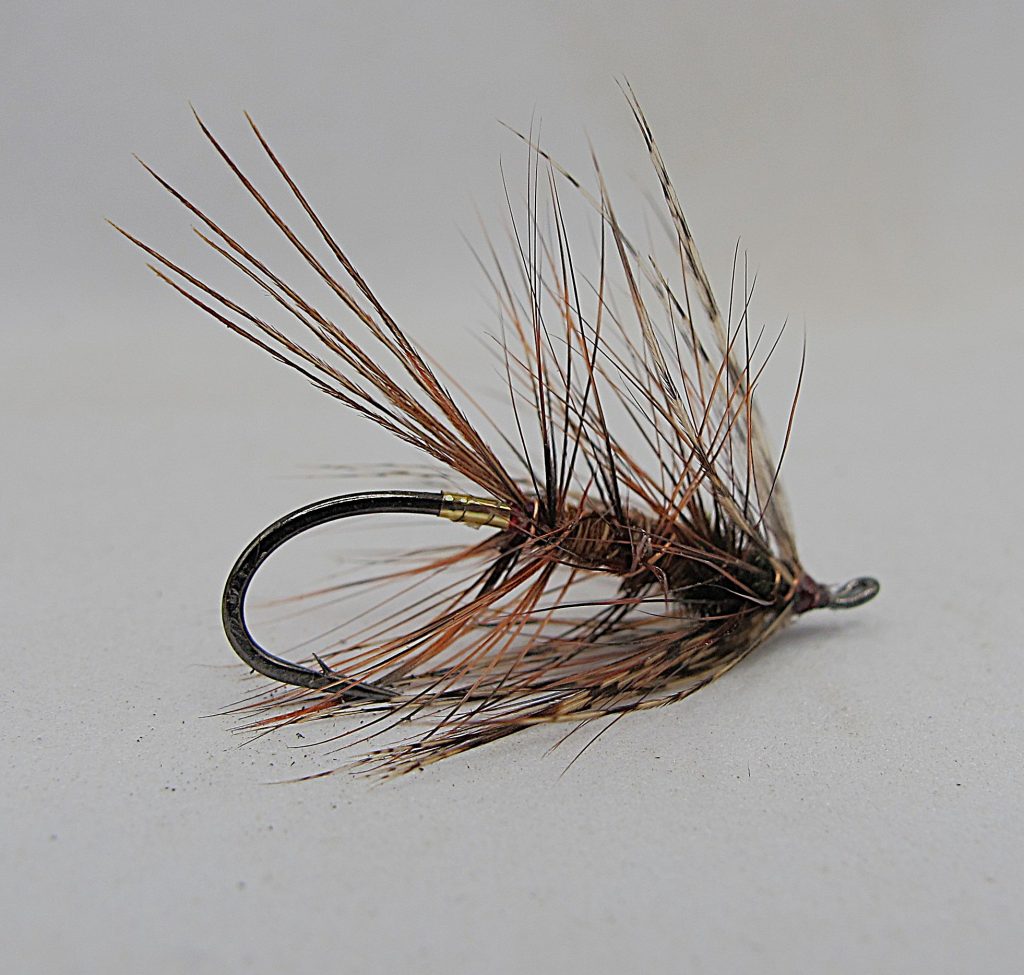
PHEASANT TAIL PALMER
- Hook: #6-#10 up-eye wetfly
- Thread: UNI 8/0 wine (or choice)
- Tag: gold tinsel (or choice)
- Tailing: pheasant tail sword tips (& or choice)
- Rib: copper wire (or choice)
- Body: cock ringneck pheasant tail swords twisted with the tying thread
- – 7 swords for a #10 (On hooks #10 & larger, the body is tied in two
- segments. The rear segment is tied in on top of the hook shank with the
- tips forming the tail. Twist the swords around the tying thread then wind
- forward until you run out of material, tie in another clump & continue
- winding forward into the thorax area, apply a few turns of thread, tie in 2 or 3 strands of peacock herl, twist it with the thread & wind forward for a short thorax.
- Palmer: brown grizzly saddle (Leaving room for the hackle collar, tie in
- the butt of the saddle hackle ahead of the thorax, apply 2 turns together then 4 turns to the end of the body, fasten down the saddle tip with a turn of the wire ribbing then wind forward 5 turns over the saddle hackle.)
- Collar: Partridge (or choice)
Excerpted from Steven Bird’s upcoming book: Spiders & Spades for
Salmon, Steelhead & Larger Trout